
Table of Contents
This is one of the most important questions in process safety. The short answer is:
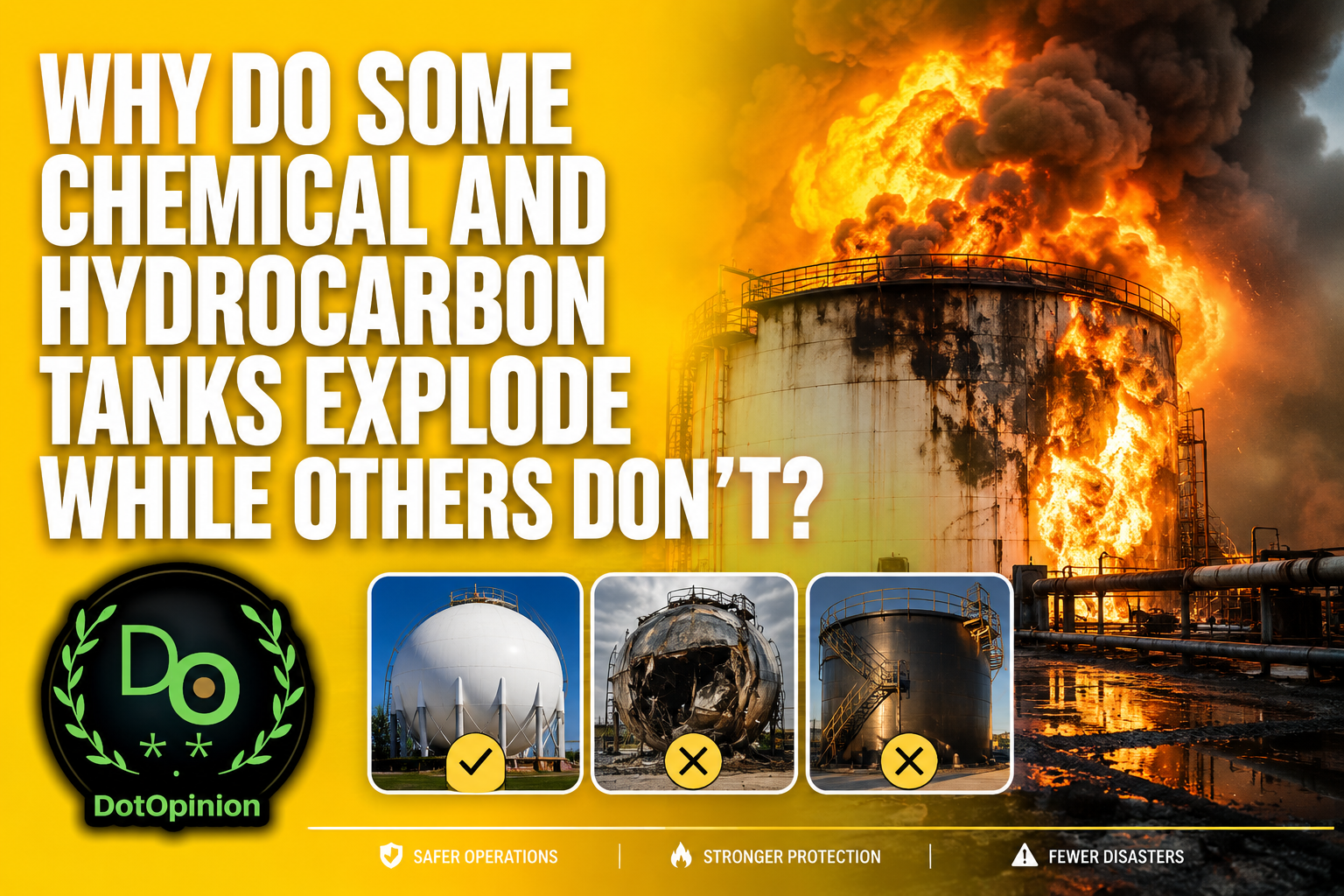
Tank Fire does not always lead to an explosion. Whether a hydrocarbon or chemical tank explodes depends on fuel concentration, confinement, pressure buildup, ignition conditions, and the condition of the tank.
Here are the main reasons.
1. Fuel-Air Mixture (Most Important)
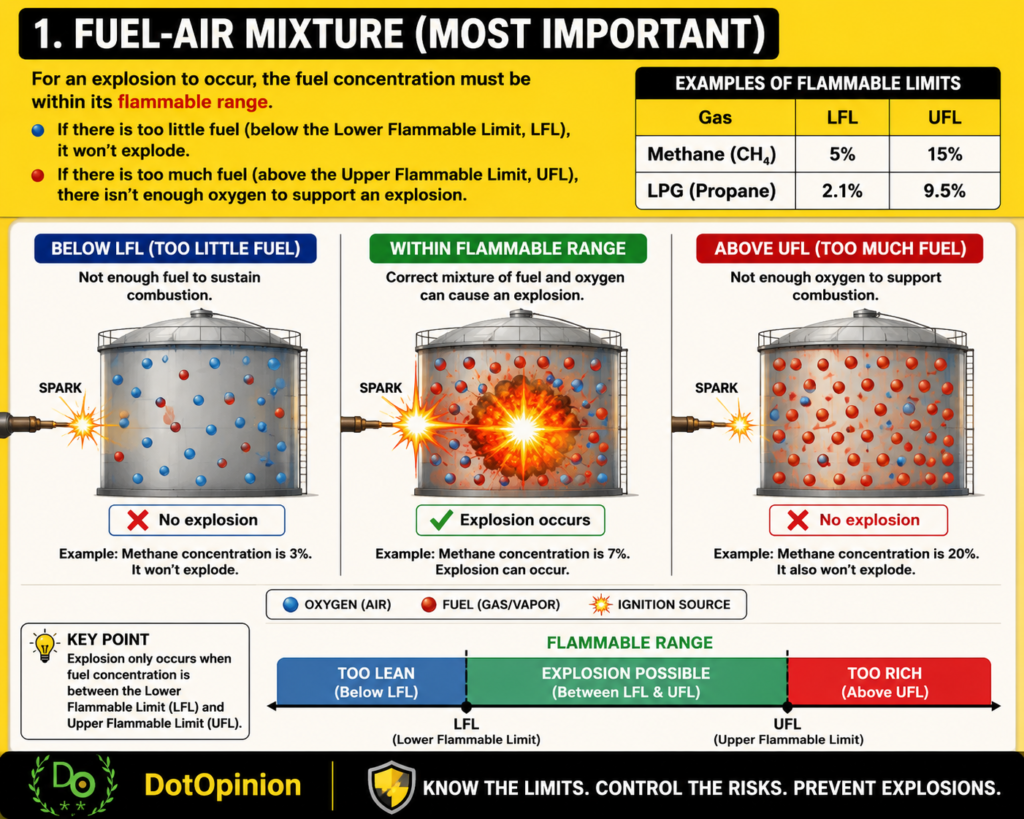
For an explosion to occur, the fuel concentration must be within its flammable range.
- If there is too little fuel (below the Lower Flammable Limit, LFL), it won’t explode.
- If there is too much fuel (above the Upper Flammable Limit, UFL), there isn’t enough oxygen to support an explosion.
For example:
| Gas | LFL | UFL |
|---|---|---|
| Methane (CH₄) | 5% | 15% |
| LPG (Propane) | 2.1% | 9.5% |
If methane concentration is 3%, it won’t explode.
If methane concentration is 20%, it also won’t explode until fresh air mixes with it.
2. Tank Pressure
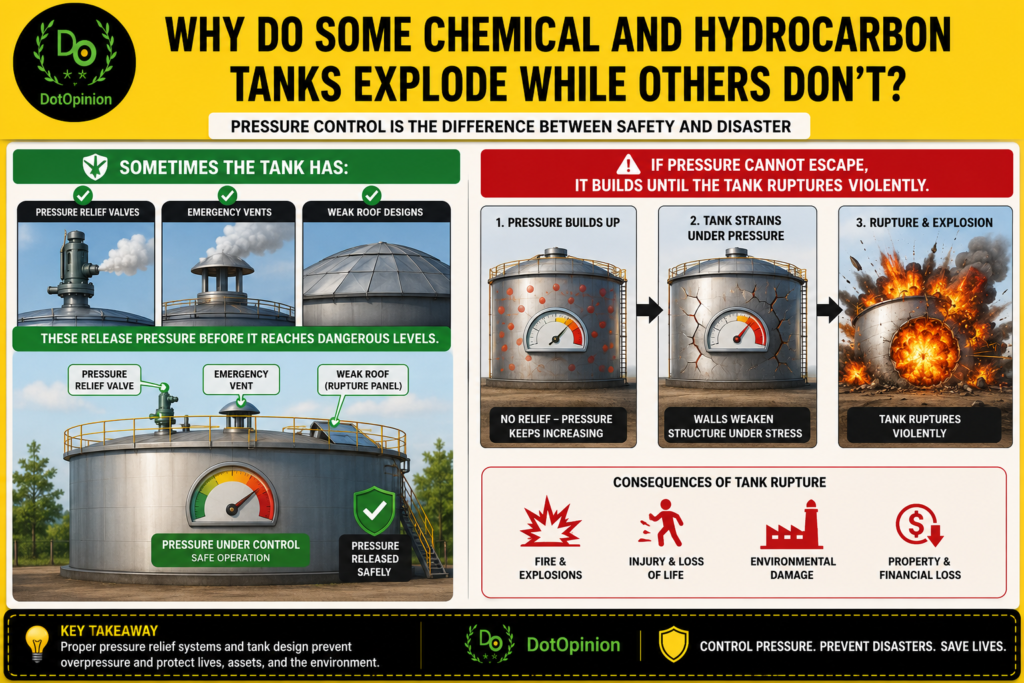
Sometimes the tank has:
- Pressure relief valves
- Emergency vents
- Weak roof designs
These release pressure before it reaches dangerous levels.
If pressure cannot escape, it builds until the tank ruptures violently.
3. Is the Tank Open or Closed?
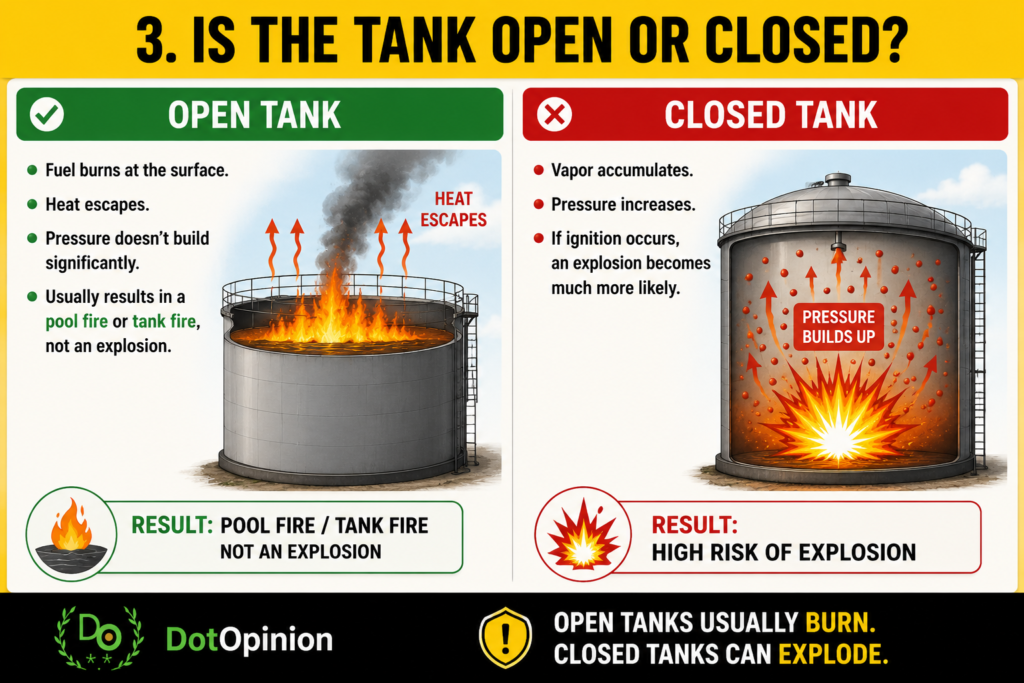
Open tank
- Fuel burns at the surface.
- Heat escapes.
- Pressure doesn’t build significantly.
- Usually results in a pool fire or tank fire, not an explosion.
Closed tank
- Vapor accumulates.
- Pressure increases.
- If ignition occurs, an explosion becomes much more likely.
4. Type of Fuel
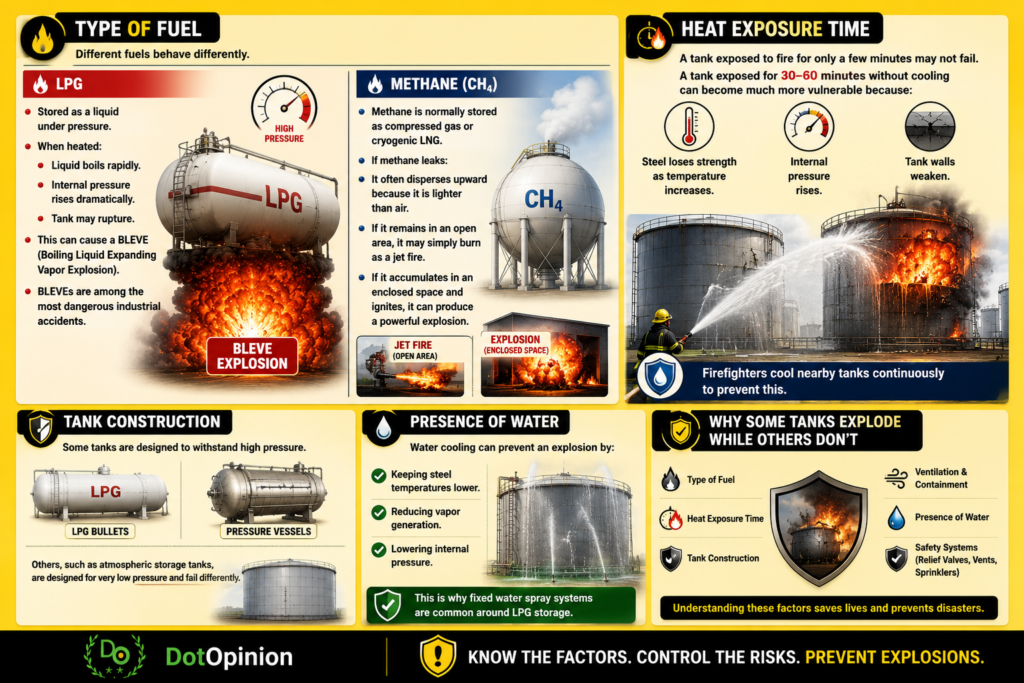
Different fuels behave differently.
LPG
Stored as a liquid under pressure.
When heated:
- Liquid boils rapidly.
- Internal pressure rises dramatically.
- Tank may rupture.
This can cause a BLEVE (Boiling Liquid Expanding Vapor Explosion).
BLEVEs are among the most dangerous industrial accidents.
Methane (CH₄)
Methane is normally stored as compressed gas or cryogenic LNG.
If methane leaks:
- It often disperses upward because it is lighter than air.
- If it remains in an open area, it may simply burn as a jet fire.
- If it accumulates in an enclosed space and ignites, it can produce a powerful explosion.
5. Heat Exposure Time
A tank exposed to fire for only a few minutes may not fail.
A tank exposed for 30–60 minutes without cooling can become much more vulnerable because:
- Steel loses strength as temperature increases.
- Internal pressure rises.
- Tank walls weaken.
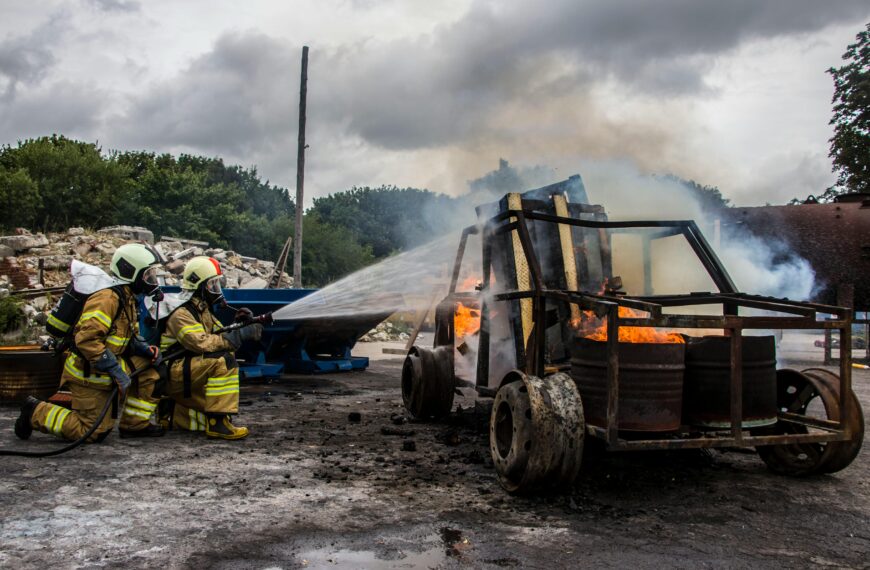
Firefighters cool nearby tanks continuously to prevent this.
6. Tank Construction
Some tanks are designed to withstand high pressure.
Examples include:
- LPG bullets
- Pressure vessels
Others, such as atmospheric storage tanks, are designed for very low pressure and fail differently.
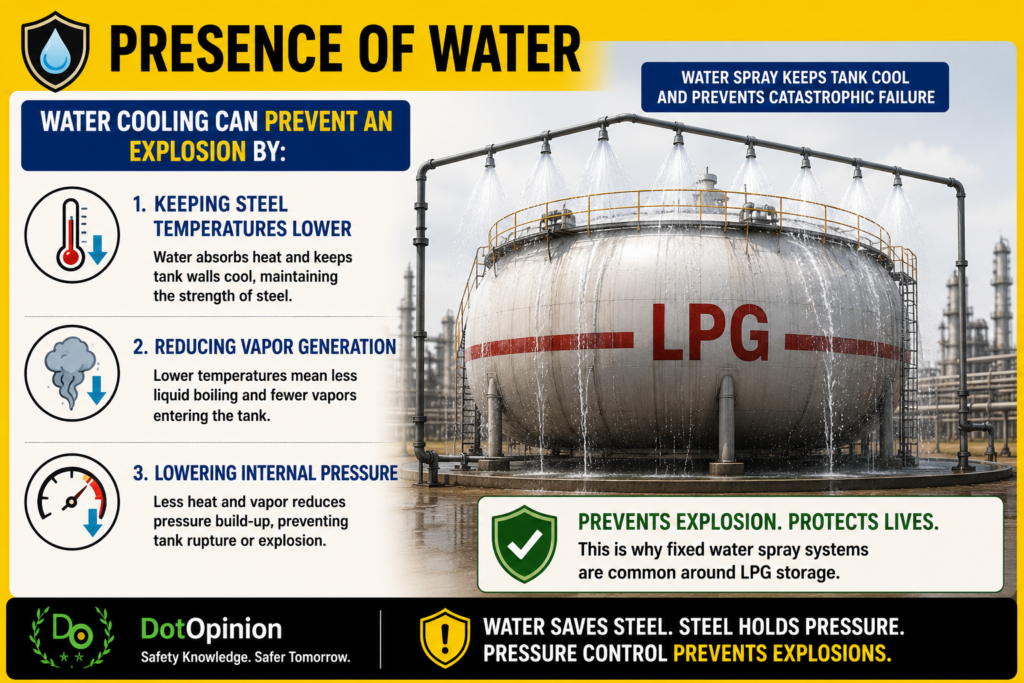
7. Presence of Water
Water cooling can prevent an explosion by:
- Keeping steel temperatures lower.
- Reducing vapor generation.
- Lowering internal pressure.
This is why fixed water spray systems are common around LPG storage.
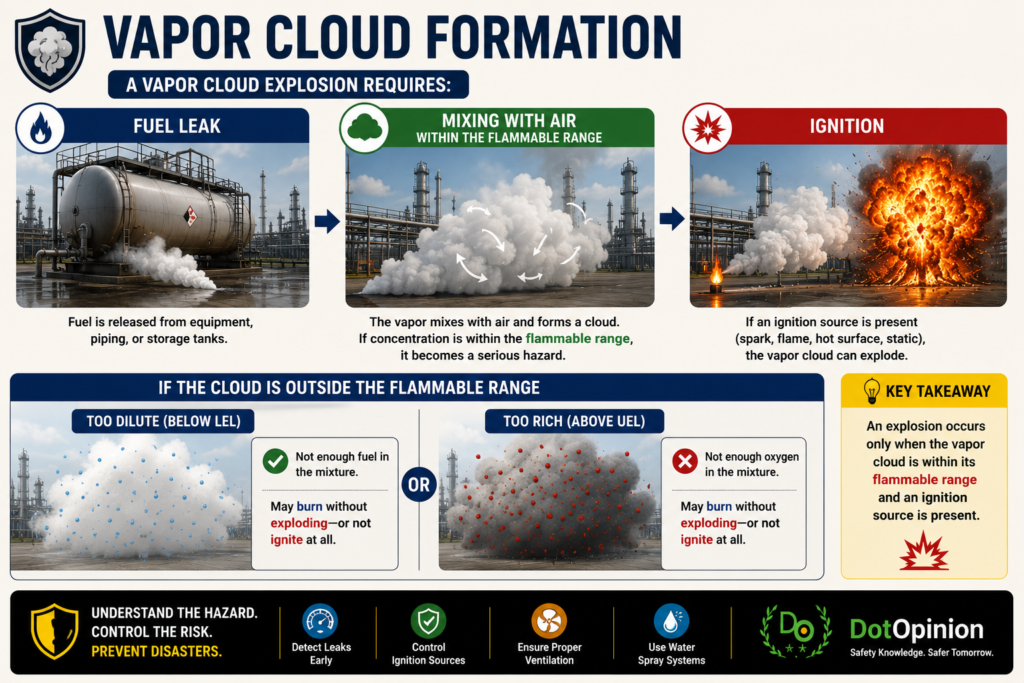
8. Vapor Cloud Formation
A vapor cloud explosion requires:
- A fuel leak
- Mixing with air within the flammable range
- Ignition
If the cloud is too dilute or too rich, it may burn without exploding—or not ignite at all.
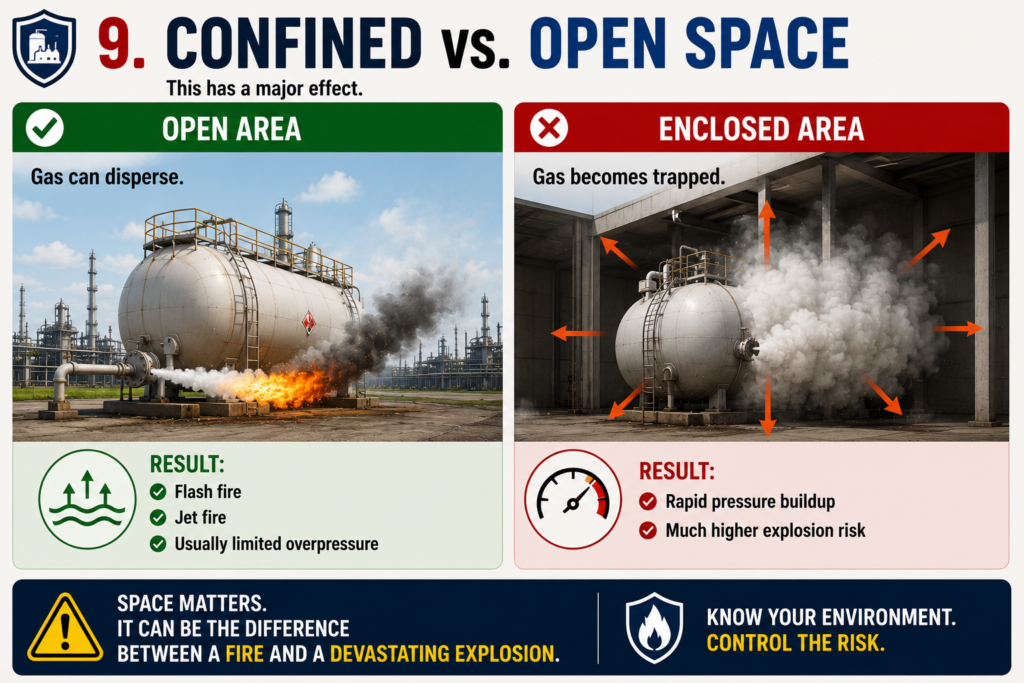
9. Confined vs. Open Space
This has a major effect.
Open area
Gas can disperse.
Result:
- Flash fire
- Jet fire
- Usually limited overpressure
Enclosed area
Gas becomes trapped.
Result:
- Rapid pressure buildup
- Much higher explosion risk
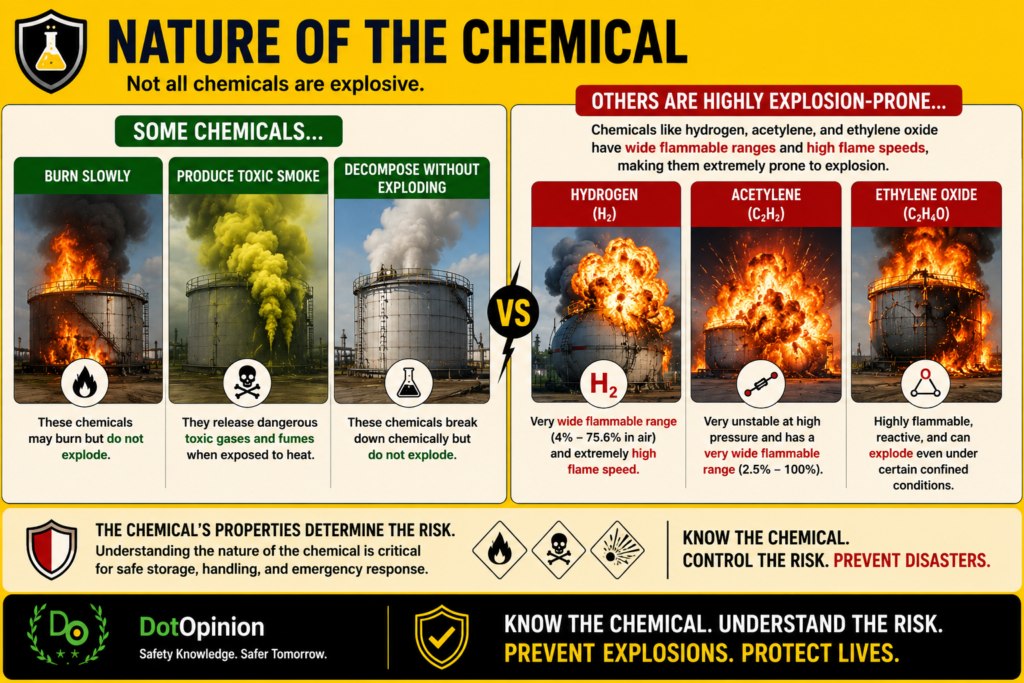
10. Nature of the Chemical
Not all chemicals are explosive.
Some:
- Burn slowly.
- Produce toxic smoke.
- Decompose without exploding.
Others, such as hydrogen, acetylene, or ethylene oxide, are highly explosion-prone because of their wide flammable ranges and high flame speeds.
Why do some burning tanks explode while others do not?
A tank may burn for hours without exploding if:
- Pressure relief devices work properly.
- Vapors remain outside the explosive range.
- The tank is adequately cooled.
- Structural integrity is maintained.
- Pressure does not build excessively.
A tank may explode if:
- Relief valves fail or cannot keep up.
- Fire heats the liquid and vapor space rapidly.
- Pressure exceeds the tank’s design strength.
- The steel weakens due to high temperatures.
- The vessel ruptures, releasing a large amount of flammable material that ignites.
Example: LPG Tank Fire
- Fire heats the LPG tank.
- LPG temperature rises.
- Liquid expands and vaporizes.
- Internal pressure increases.
- Steel above the liquid level becomes very hot and weak.
- If cooling or pressure relief is inadequate, the tank ruptures.
- The sudden release and ignition of the contents can produce a BLEVE, with a powerful blast wave and a large fireball.
Key takeaway
An explosion requires more than just fire. It generally needs a flammable fuel-air mixture, sufficient confinement or rapid pressure rise, and ignition. Whether a hydrocarbon or chemical tank burns, vents safely, or explodes depends on the interaction of these factors, along with the tank design, operating conditions, and emergency protection systems. This is why two tanks exposed to seemingly similar fires can behave very differently.
Things you can Discover
- Occupational Safety and Health Administration (OSHA) – Process Safety Management (PSM)
- National Fire Protection Association (NFPA) – Fire and Explosion Safety
- Center for Chemical Process Safety (CCPS) – AIChE
- Occupational Health & Safety
- Environmental Pollutions

 By
By