
Introduction
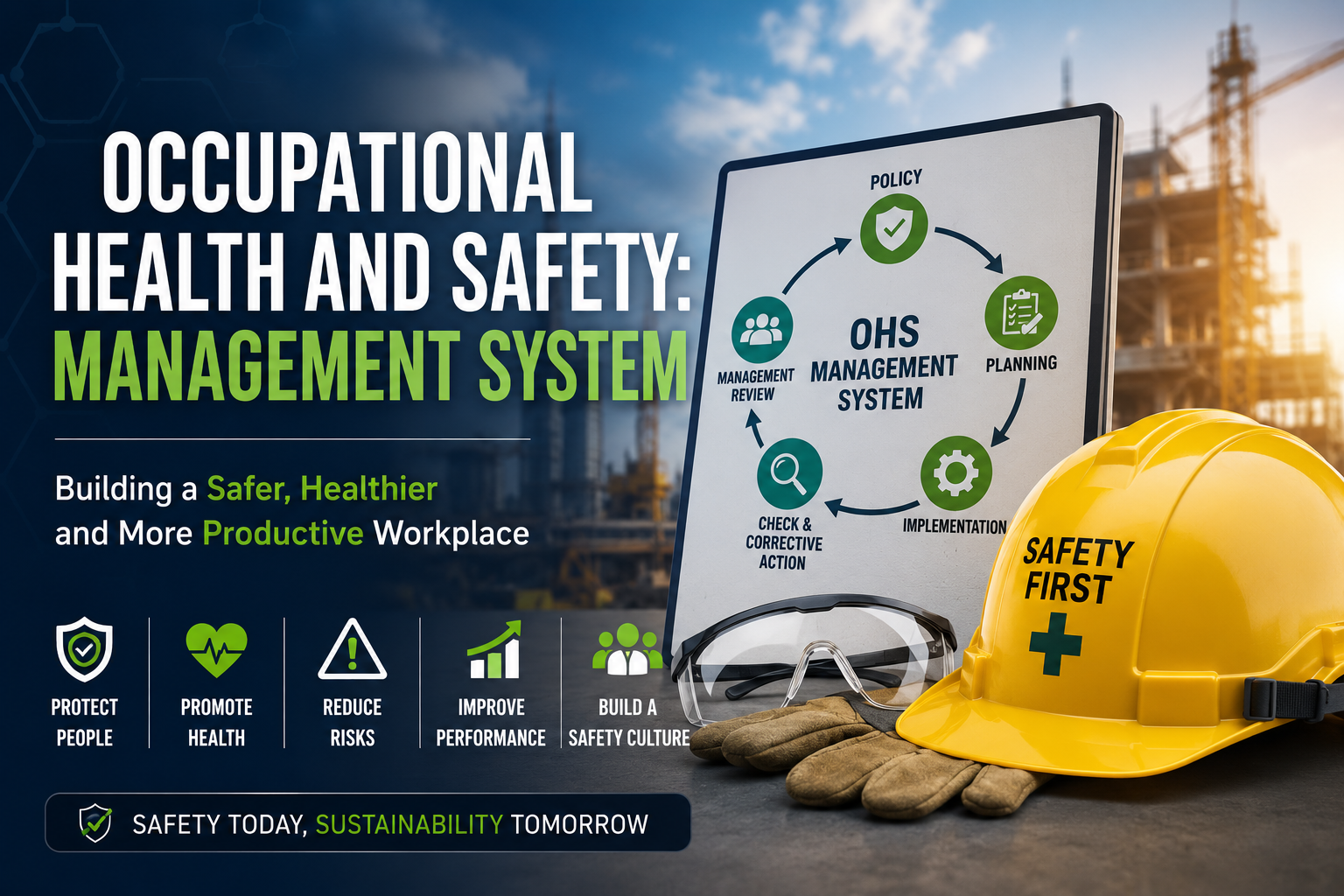
Occupational Health and Safety (OHS), also called Occupational Safety and Health (OSH), is the discipline concerned with protecting the safety, health, and welfare of people engaged in work or employment. The primary goal of OHS is to foster a safe and healthy work environment by identifying hazards, controlling risks, and building a culture where workers, supervisors, and management share responsibility for preventing injury, illness, and property loss. A strong OHS program is not a single document or a poster on a wall — it is a living system made up of hazard identification, risk assessment, control measures, training, permits, inspections, and continuous improvement. This essay walks through the foundational building blocks of OHS in the sequence they are normally applied in a workplace, starting with the core concepts of hazard and risk, moving through the management systems that support safe work (reporting, investigation, assessment, and control), and finishing with the specific high-risk work permits and completion procedures used in industrial and construction settings.
1. Hazard
A hazard is any source, situation, or act with the potential to cause harm to people, property, the environment, or a combination of these. A hazard exists whether or not anyone is currently exposed to it; it is the “thing” that could go wrong. Hazards are generally grouped into categories:
- Physical hazards — noise, vibration, extreme temperatures, radiation, poor lighting, moving machinery parts.
- Chemical hazards — flammable solvents, corrosive acids, toxic fumes, dust, asbestos.
- Biological hazards — bacteria, viruses, mold, bloodborne pathogens.
- Ergonomic hazards — repetitive motion, awkward postures, poor workstation design, manual handling of heavy loads.
- Psychosocial hazards — workplace violence, bullying, excessive workload, shift work fatigue.
- Mechanical/Electrical hazards — unguarded machinery, exposed live wires, pressurized systems.
Examples: A frayed electrical cable lying across a walkway is a hazard even before anyone touches it. A wet floor in a kitchen is a hazard whether or not a worker is walking on it at that moment. An open excavation pit is a hazard to anyone who might approach the edge.
2. Risk
Risk is the likelihood that a hazard will actually cause harm, combined with the severity of that harm if it occurs. Risk is often expressed conceptually as:
Risk = Likelihood (Probability) × Severity (Consequence)
While a hazard is the source of danger, risk describes the real-world exposure to that danger. Two workplaces can have the same hazard but very different risk levels depending on exposure, control measures, and frequency of contact.
Examples: The frayed electrical cable mentioned above becomes a high risk if it sits in a busy corridor used by hundreds of workers daily and carries a high voltage, but a lower risk if it is in a rarely accessed store room and has already been isolated at the source. Working at two meters height without a harness carries a lower risk than working at twenty meters height without one, even though both situations involve the same hazard category — fall from height.
Understanding the distinction between hazard and risk is the foundation of every subsequent OHS process: you cannot assess or control risk without first identifying the hazard that creates it.
3. Reporting Procedures
Reporting procedures are the formal channels through which employees communicate hazards, near-misses, incidents, and accidents to supervisors and the safety department. A functioning reporting system is the nervous system of an OHS program — without it, management has no visibility into what is actually happening on the ground.
Key elements of a good reporting procedure include:
- Near-miss reporting — encouraging workers to report situations that could have caused harm but did not, without fear of blame.
- Hazard reporting cards or apps — simple, accessible tools (paper cards, mobile apps, hotlines) so any worker can flag a hazard immediately.
- Incident/accident reporting forms — a standardized form capturing date, time, location, persons involved, description, witnesses, and immediate actions taken.
- Chain of communication — worker → supervisor → HSE officer → site/plant manager, with timeframes for escalation (e.g., serious incidents reported within 1 hour, near-misses within 24 hours).
- Non-punitive culture — workers must feel safe reporting issues; a “blame culture” suppresses reporting and hides real risk levels.
Example: A warehouse worker notices a pallet racking bracket has come loose. Instead of ignoring it, they fill out a hazard report card, hand it to their supervisor, and the area is cordoned off until maintenance repairs the rack — preventing a potential collapse.
4. Accident Investigation
When an incident does occur, accident investigation is the structured process of determining what happened, why it happened, and what must change to prevent recurrence. Good investigations focus on systemic root causes, not on assigning individual blame.
Typical steps in accident investigation:
- Secure the scene — prevent further injury and preserve evidence.
- Provide first aid/medical care — always the first priority.
- Gather evidence — photographs, witness statements, equipment logs, CCTV footage.
- Establish the timeline — sequence of events leading up to the incident.
- Root cause analysis — using tools such as the “5 Whys” or a Fishbone (Ishikawa) diagram to distinguish immediate causes (e.g., a slip) from underlying causes (e.g., no wet-floor signage policy).
- Corrective and preventive actions (CAPA) — concrete steps with owners and deadlines.
- Report and communicate findings — share lessons learned across the organization, not just the affected department.
Example: A forklift collides with a pedestrian in a warehouse aisle. Investigation reveals the immediate cause was the driver’s limited visibility around a blind corner, but the root cause was the absence of a pedestrian-vehicle segregation plan and mirrors at the junction. The corrective action includes installing convex mirrors, painting pedestrian walkways, and retraining drivers — not simply disciplining the driver.
5. Risk Assessment
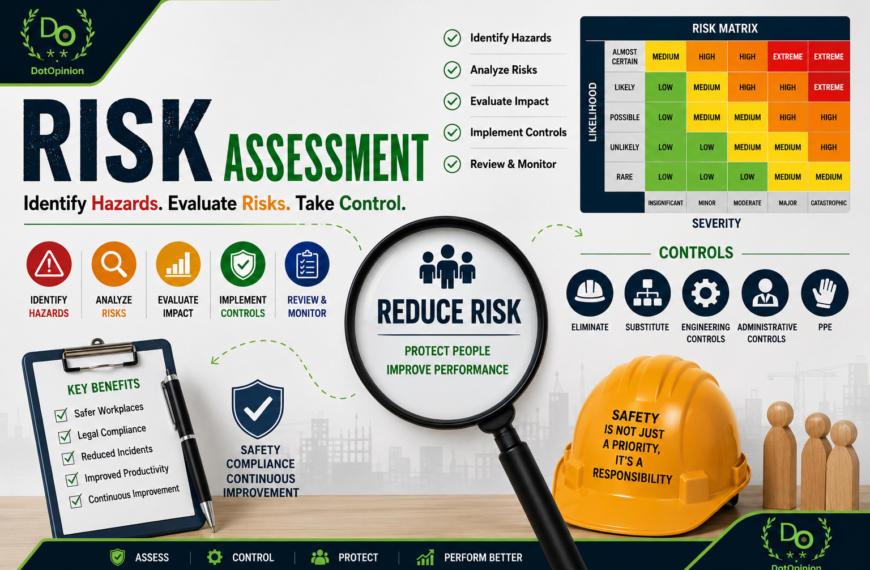
Risk assessment is the systematic process of identifying hazards, analyzing and evaluating the associated risk, and determining suitable control measures before work begins. It converts the abstract concept of hazard and risk into a practical, documented decision-making tool.
Standard risk assessment steps:
- Identify the hazards in the task or area.
- Determine who might be harmed and how.
- Evaluate the risk — often using a risk matrix that scores likelihood (1–5) against severity (1–5) to produce a risk rating (e.g., Low, Medium, High, Extreme).
- Decide on control measures using the hierarchy of controls (see next section).
- Record the findings in a formal risk assessment document.
- Review and update periodically or when conditions change.
Example: Before a team repaints a storage tank’s interior, a risk assessment identifies hazards including toxic fume buildup, confined space entrapment, and slip hazards from wet paint. Likelihood is rated “possible” and severity “major” (potential asphyxiation), giving a High risk rating. Controls include forced ventilation, continuous gas monitoring, a permit-to-work, and a stand-by rescue person.
6. Hazard Control (Hierarchy of Controls)
Once risks are assessed, hazard control measures must be applied following the internationally recognized Hierarchy of Controls, ranked from most to least effective:
- Elimination — physically remove the hazard (e.g., discontinue use of a hazardous chemical).
- Substitution — replace the hazard with something less dangerous (e.g., use a water-based adhesive instead of a solvent-based one).
- Engineering controls — isolate people from the hazard (e.g., machine guarding, ventilation systems, noise enclosures).
- Administrative controls — change the way people work (e.g., job rotation, safety signage, standard operating procedures, reduced exposure time).
- Personal Protective Equipment (PPE) — the last line of defense, worn by the individual.
Example: In a factory with high noise levels, the ideal solution is elimination or substitution of noisy machinery. If that’s not feasible, engineering controls like acoustic enclosures are applied. Administrative controls might limit exposure time per shift. Only after these are exhausted should hearing protection (PPE) be relied upon as the final barrier.
7. Personal Protective Equipment (PPE)
PPE refers to equipment worn to minimize exposure to hazards that cannot be fully eliminated through other controls. PPE must be selected based on the specific hazard, properly fitted, maintained, and workers must be trained in its correct use.
Common categories:
- Head protection — hard hats (protect against falling objects).
- Eye and face protection — safety goggles, face shields (protect against chemical splash, flying debris, welding arc flash).
- Hearing protection — earplugs, earmuffs (protect against noise-induced hearing loss).
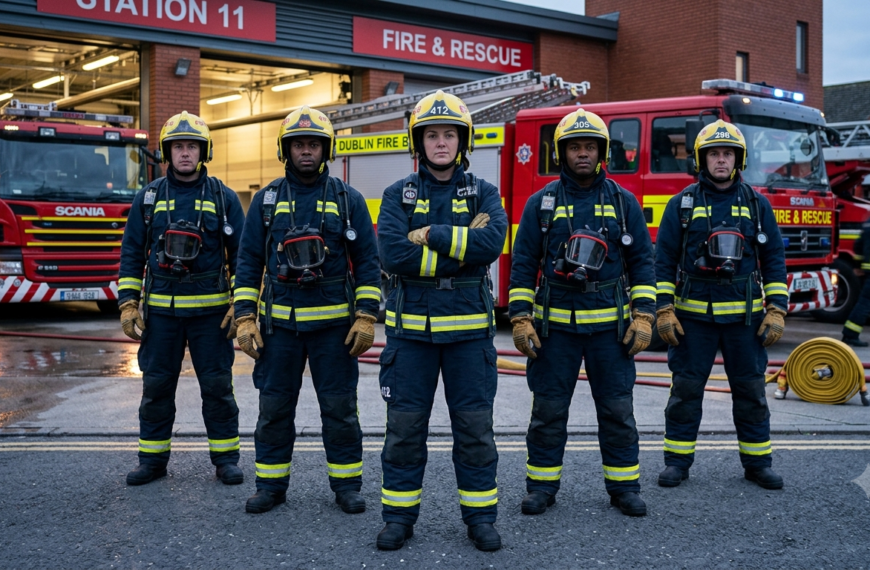
- Respiratory protection — dust masks, half-face respirators, self-contained breathing apparatus (SCBA) for toxic or oxygen-deficient atmospheres.
- Hand protection — cut-resistant gloves, chemical-resistant gloves, insulated gloves for electrical work.
- Foot protection — steel-toe boots, anti-slip soles, electrical-hazard-rated boots.
- Body protection — flame-resistant coveralls, high-visibility vests, chemical suits.
- Fall protection — full-body harnesses, lanyards, and anchor points for work at height.
Example: A welder requires an auto-darkening welding helmet, flame-resistant gloves and apron, safety boots, and respiratory protection against metal fumes — a combination selected specifically for the hazards of arc welding.
8. Zoning of Areas
Zoning is the practice of dividing a worksite into designated areas based on hazard level and access control, using barriers, signage, and color-coded markings to manage traffic and restrict entry.
Common zoning practices:
- Red zones / exclusion zones — high-hazard areas (e.g., crane lifting radius, blasting zones) where entry is strictly prohibited during operations.
- Amber/yellow zones — caution areas requiring PPE or supervision.
- Green zones — general safe walkways and assembly points.
- Pedestrian vs. vehicle segregation — clearly marked walkways separate from forklift or truck routes.
- Barricading and signage — physical barriers (tape, cones, hard barricades) combined with warning signs.
Example: During crane lifting operations on a construction site, a red exclusion zone equal to the crane’s working radius plus a safety margin is barricaded off, with a banksman controlling access, ensuring no personnel are under a suspended load.
9. Training
Training ensures that workers, supervisors, and managers have the knowledge and competence to work safely. OHS training is not a one-time event; it should be structured, recurring, and role-specific.
Types of training include:
- Induction/orientation training — for all new workers before starting any task.
- Job-specific/task training — e.g., forklift operation, working at height, confined space entry.
- Toolbox talks — short, frequent briefings (10–15 minutes) on specific hazards relevant to the day’s work.
- Emergency response training — fire drills, first aid, evacuation procedures.
- Refresher training — periodic retraining to maintain competency and update on regulatory changes.
- Permit-issuer and permit-receiver training — specialized training for anyone involved in high-risk permit work.
Example: Before operating a mobile elevated work platform (MEWP), an operator must complete certified training, pass a practical assessment, and receive a valid license/certificate before being authorized to work independently.
10. Scaffolding Safety
Scaffolding is temporary structure used to support workers and materials during construction, maintenance, or repair at height. Because scaffolds are frequently modified and dismantled, they carry significant collapse and fall risk if not properly managed.
Key scaffolding safety requirements:
- Scaffolds must be erected, altered, and dismantled only by competent, trained personnel.
- Base plates and sole boards must be used on firm, level ground to prevent settlement.
- Guardrails, mid-rails, and toe boards must be installed on all open edges.
- Scaffolds must be tagged — typically a color-coded tag (e.g., green = safe to use, red = do not use, yellow = use with caution/restrictions) — and inspected before each shift.
- Weekly formal inspections by a competent scaffold inspector, with records maintained.
- Maximum load limits must be posted and never exceeded.
- Scaffolds must be tied to the structure at required intervals for stability.
Example: A scaffold erected for facade repair on a five-story building is tagged green after inspection, with double guardrails and toe boards installed. After a storm, the scaffold is re-inspected and re-tagged before workers are permitted to climb it again.
11. Food Safety
In workplaces involving food handling — canteens, catering, food processing — food safety is a specialized branch of OHS protecting both workers and consumers from foodborne illness.
Core principles:
- Personal hygiene — handwashing, clean uniforms, hair restraints, no jewelry.
- Temperature control — keeping hot food above 60°C and cold food below 5°C to prevent bacterial growth (the “danger zone” is 5–60°C).
- Cross-contamination prevention — separate cutting boards and storage for raw and cooked food.
- HACCP (Hazard Analysis and Critical Control Points) — a systematic preventive approach identifying critical points in food handling where contamination risk must be controlled.
- Pest control — regular inspections and pest management programs.
- Allergen management — clear labeling and staff awareness of common allergens.
Example: In a site canteen, raw chicken is stored on the bottom shelf of the refrigerator, separate from ready-to-eat salads, and cooked to a verified internal temperature of 75°C to eliminate Salmonella risk — a direct HACCP control point.
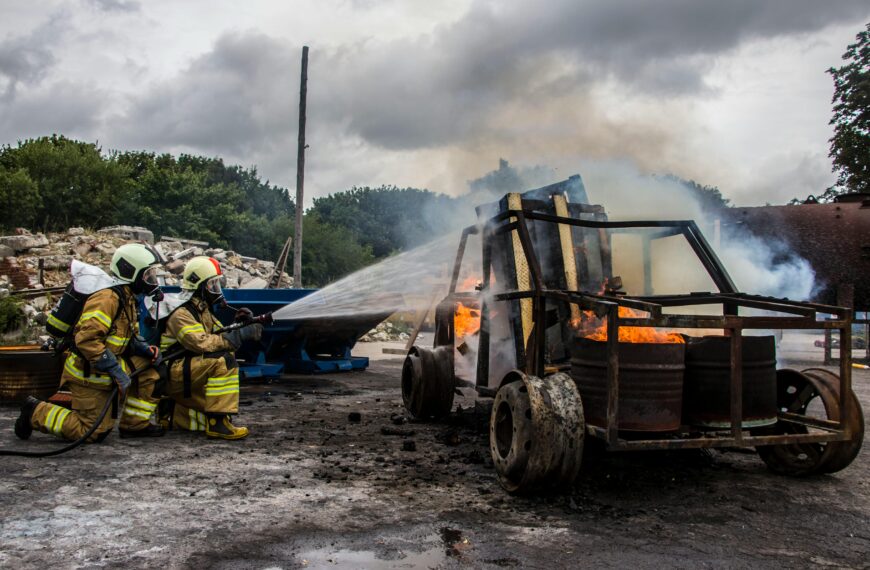
12. Fire Safety
Fire safety involves preventing fire ignition and ensuring safe evacuation and suppression if a fire occurs. Fire requires three elements — heat, fuel, and oxygen (the “fire triangle”) — and control measures aim to break this triangle.
Key components:
- Fire risk assessment — identifying ignition sources, fuel loads, and escape routes.
- Fire detection and alarm systems — smoke detectors, heat detectors, manual call points.
- Fire suppression equipment — fire extinguishers (matched to fire class: A for solids, B for flammable liquids, C for gases, D for metals, K for cooking oils/fats), sprinkler systems, fire hose reels.
- Means of escape — clearly marked, unobstructed emergency exits and assembly points.
- Fire drills — regular practice evacuations to ensure familiarity with procedures.
- Hot work controls — permits required for welding, cutting, or grinding near combustible materials.
Example: A warehouse storing flammable solvents installs Class B foam extinguishers at intervals, maintains clear 3-meter-wide escape aisles, and requires a hot work permit with a fire watch present for any welding conducted nearby.
13. Electrical Safety
Electrical hazards can cause shock, burns, arc flash, and fire. Electrical safety programs focus on preventing contact with live parts and ensuring equipment integrity.
Core measures:
- Lockout-Tagout (LOTO) — isolating and locking energy sources before maintenance, with a tag identifying who applied the lock.
- Insulation and grounding/earthing of equipment.
- Residual Current Devices (RCDs)/Ground Fault Circuit Interrupters (GFCIs) to cut power in case of leakage current.
- Regular inspection and testing of cables, plugs, and portable equipment (PAT testing).
- Qualified electricians only for live work, and only under a permit system.
- Arc flash PPE for high-voltage work.
Example: Before repairing a motor control panel, a technician applies lockout-tagout — switching off the breaker, locking it with a personal padlock, and attaching a danger tag — then verifies zero energy with a voltage tester before beginning work.
14. Permit to Work (PTW) System
A Permit to Work is a formal, documented control system used to manage high-risk activities. It ensures that before work begins, hazards have been assessed, controls are in place, and all parties understand the scope and limitations of the job. A PTW is typically issued by an authorized person (permit issuer), accepted by the person performing the work (permit receiver), and closed out upon completion.
General requisites common to all permits:
- Clear description and location of the work.
- Validity period (start and expiry time — most permits are valid for a single shift only).
- Named permit issuer and receiver, with signatures.
- Hazard identification and risk assessment attached or referenced.
- Control measures and precautions specified (isolation, PPE, monitoring).
- Emergency arrangements (rescue plan, nearest first aid, emergency contacts).
- Permit suspension/cancellation conditions (e.g., in case of alarm, weather change, or gas detection).
- Sign-off/closure confirming the area is left safe.
Below are the major types of high-risk work permits and their specific requisites.
14.1 Work at Height Permit
Required for any work performed above a defined height threshold (commonly 1.8–2 meters, though local regulation varies) where a fall could cause injury.
Requisites:
- Confirmation of a documented risk assessment for the specific task.
- Verification of fall protection equipment (harness, lanyard, anchor points) and its inspection status.
- Weather check (no work at height during high wind, lightning, or heavy rain).
- Barricading of the area below to prevent dropped-object injury.
- Rescue plan in case of a suspended worker after a fall.
- Training certification of workers involved.
Example: A technician replacing a rooftop HVAC unit obtains a work-at-height permit confirming a fall-arrest system is anchored to a rated point, the roof edge is barricaded, and a rescue kit is on standby.
14.2 Confined Space Entry Permit
Required for entry into any enclosed or partially enclosed space not designed for continuous occupancy, with restricted entry/exit and potential for hazardous atmosphere (e.g., tanks, silos, pits, sewers, vessels).
Requisites:
- Atmospheric testing before entry and continuously during work — oxygen level (normally 19.5–23.5%), flammable gas (%LEL), and toxic gas concentrations.
- Ventilation (forced air) confirmed.
- Isolation of the space from any inflow of product, gas, or energy (blinding, blanking, LOTO).
- A dedicated attendant/standby person stationed outside at all times.
- Rescue and retrieval equipment (tripod, winch, harness) ready.
- Communication method between entrant and attendant.
- Maximum allowable entry duration and headcount.
Example: Before entry into a fuel storage tank for cleaning, gas testing confirms oxygen at 20.9% and zero flammable vapor; a standby attendant remains at the manhole with a radio and rescue tripod throughout the job.
14.3 Hot Work Permit
Required for any activity producing heat, sparks, or open flame — welding, cutting, grinding, brazing.
Requisites:
- Removal or protection of combustible materials within a defined radius (commonly 10–15 meters).
- Fire extinguisher and fire watch present during and for a period after work (commonly 30–60 minutes, “fire watch” period).
- Gas cylinder and hose inspection (for oxy-fuel welding).
- Confirmation area is not classified as flammable-atmosphere (or additional gas testing if near one).
- Screens/curtains to contain sparks and prevent arc flash exposure to others.
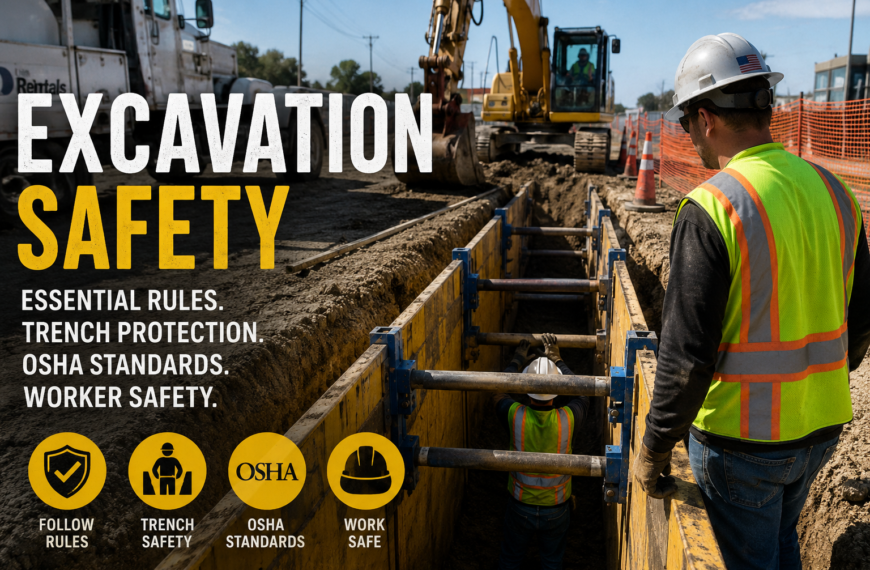
14.4 Excavation Permit
Required before digging trenches, pits, or any ground disturbance, due to risks of collapse, striking underground utilities, or falls into the excavation.
Requisites:
- Underground utility survey/clearance (cable, gas line, water line locating) before digging begins.
- Shoring, benching, or sloping requirements based on soil type and depth (excavations deeper than ~1.2–1.5 meters typically require protective systems).
- Edge protection and barricading to prevent falls or vehicles driving into the excavation.
- Spoil placement at a safe distance from the edge (commonly at least 1 meter back) to prevent collapse from surcharge load.
- Means of access/egress (ladder) within the trench, spaced appropriately (e.g., every 7–8 meters).
- Atmospheric testing if the excavation is deep or in contaminated ground (may overlap with confined space requirements).
- Daily competent-person inspection, especially after rain or ground disturbance.
Example: Before excavating a trench for a new water pipeline, the crew obtains utility clearance drawings confirming no live electrical cable in the path, installs trench boxes for shoring at 2-meter depth, and places excavated soil at least 1 meter from the edge.
14.5 Electrical Work Permit
Required for work on or near electrical systems, particularly isolation and live-work exceptions.
Requisites:
- Confirmation of lockout-tagout application and zero-energy verification.
- Named authorized electrical person.
- Voltage and equipment identification.
- Arc flash risk assessment for live work exceptions (with justification, as live work should be avoided wherever possible).
14.6 Cold Work / General Work Permit
Used for lower-risk but still supervised activities not covered by the specific permits above, ensuring general site hazards (e.g., working near operating equipment) are still assessed.
15. Work Completion Form
Once permitted work is finished, a Work Completion Form (or Permit Closure Form) is completed to formally close out the job and confirm the area has been returned to a safe condition. This step is often overlooked but is essential for closing the safety management loop.
Typical contents of a work completion form:
- Confirmation that the work described in the permit has been fully completed (or details of any incomplete work, with follow-up plan).
- Housekeeping confirmation — tools, materials, and debris removed from the area.
- De-isolation/restoration confirmation — energy sources restored, locks removed, guards reinstated.
- Removal of barricades, signage, and temporary controls once no longer needed (or handover if work continues into the next shift).
- Sign-off by both the permit receiver and permit issuer, confirming mutual agreement that the area is safe.
- Any incidents, near-misses, or deviations encountered during the work, to feed back into the reporting system.
- Date and time of closure.
Example: After completing hot work on a pipeline flange, the technician removes fire watch equipment, confirms no smoldering material remains, and both the technician and the area supervisor sign the work completion form, formally closing the hot work permit for that shift.
16. Additional Foundational OHS Elements
Beyond the topics above, a mature OHS system typically also includes:
- Lockout-Tagout (LOTO) Program — a standalone system (referenced above) ensuring hazardous energy (electrical, mechanical, hydraulic, pneumatic, thermal) is isolated before maintenance.
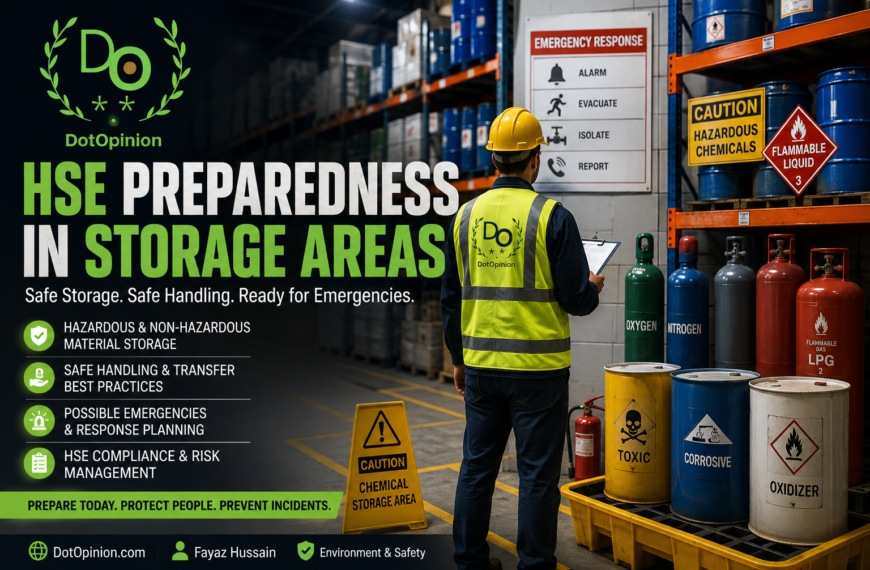
- Chemical Safety / COSHH (Control of Substances Hazardous to Health) — Safety Data Sheets (SDS), proper labeling, and storage segregation of incompatible chemicals.
- Emergency Preparedness and Response Plan — covering fire, spill, medical emergency, and natural disaster scenarios, with designated assembly points and emergency contacts.
- Housekeeping (5S methodology) — Sort, Set in order, Shine, Standardize, Sustain — reducing slip, trip, and fire hazards through orderly workspaces.
- Manual Handling and Ergonomics — safe lifting techniques, mechanical aids, and workstation design to prevent musculoskeletal disorders.
- Noise and Vibration Management — hearing conservation programs and vibration exposure limits.
- Behavior-Based Safety (BBS) — observation programs where peers identify and coach on safe/unsafe behaviors.
- Management of Change (MOC) — a formal review process whenever equipment, processes, or personnel change, to ensure new hazards are assessed before implementation.
- Audits and Inspections — periodic internal and external audits to verify the OHS system is functioning as designed, with findings tracked to closure.
- Key Performance Indicators (KPIs) — lagging indicators (Lost Time Injury Frequency Rate, Total Recordable Incident Rate) and leading indicators (number of toolbox talks, near-miss reports, inspections completed) to measure safety performance.
Conclusion
Occupational Health and Safety is best understood as an interconnected system rather than a checklist. It begins with recognizing that a hazard is a potential source of harm and risk is the realistic likelihood and severity of that harm occurring. From there, reporting procedures give the organization visibility into hazards and near-misses, accident investigation turns unfortunate events into lessons that prevent recurrence, and risk assessment converts hazard knowledge into a structured decision about how dangerous a task really is. The hierarchy of hazard control then guides the selection of the most effective controls, with PPE as the final layer of defense, supported by zoning, physical barriers, and constant training to build competence and awareness.
For specific high-risk activities — scaffolding, food handling, fire-prone environments, electrical systems, work at height, confined spaces, and excavation — the permit-to-work system ties every earlier principle together into a single, auditable authorization process, with each permit type carrying its own specific requisites suited to its unique hazards. Finally, the work completion form closes the loop, confirming the worksite has been returned to a safe state and that any lessons from the job are captured for future improvement.
When these elements work together — hazard identification, risk assessment, layered controls, trained and informed workers, disciplined permit systems, and honest reporting — organizations move from reactive safety (responding after accidents happen) to proactive safety (preventing them before they can occur). That shift is the true measure of a mature occupational health and safety culture.

 By
By