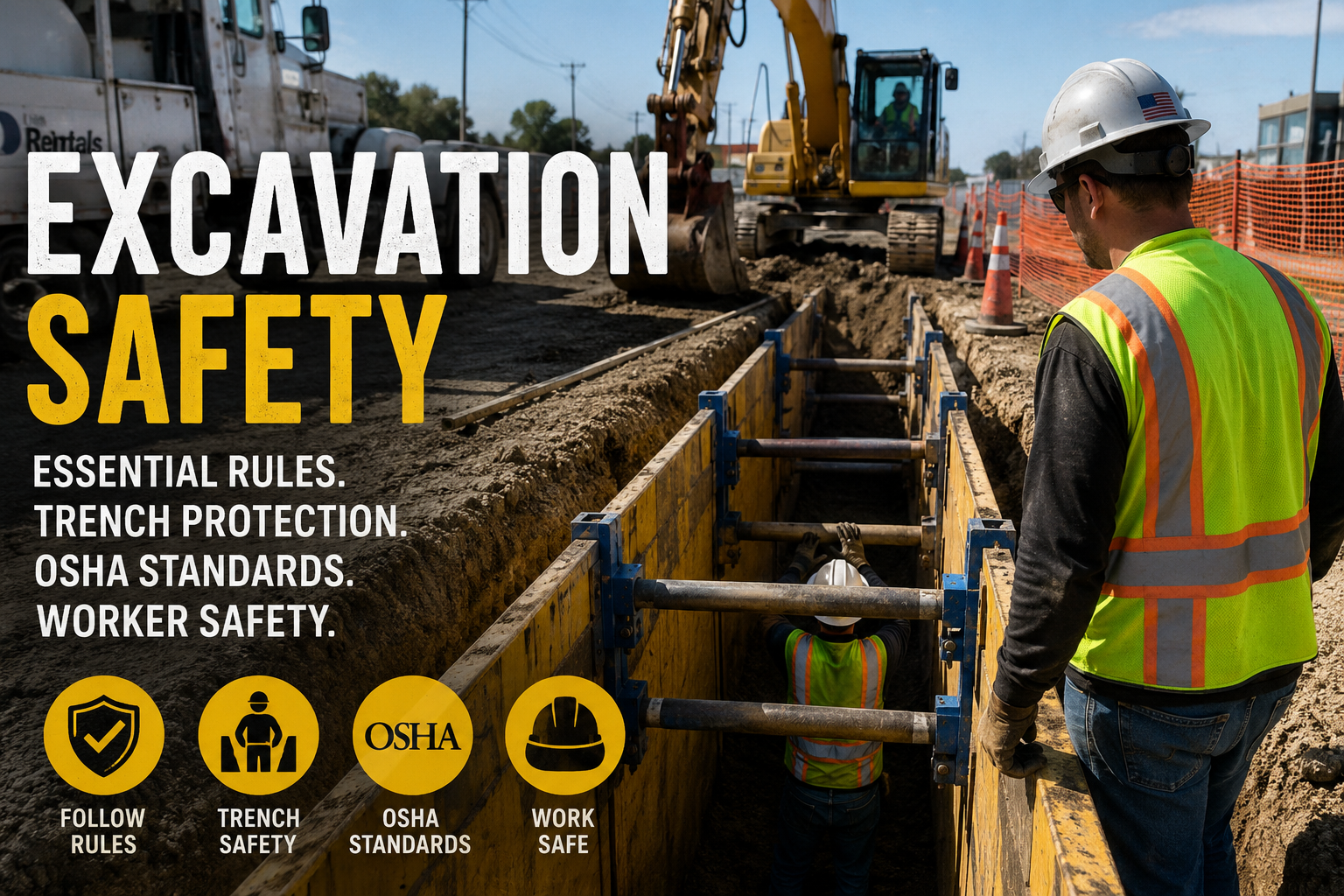

Trench Safety 101
Table of Contents
The Complete OSHA Guide to Safe Excavation Practices
Why Excavation Safety Matters
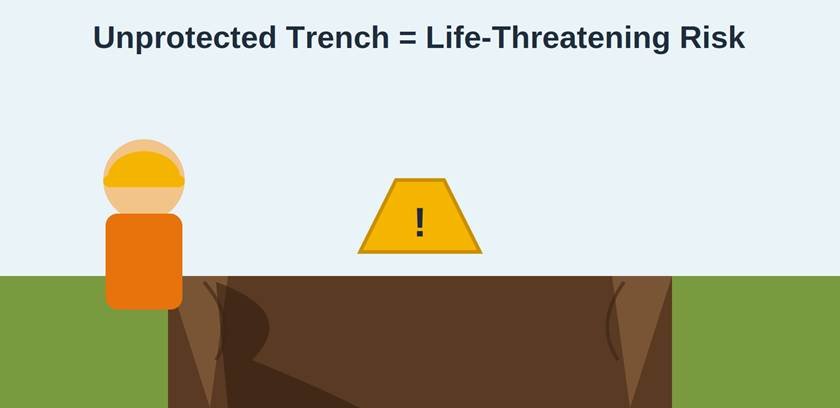
Every year, workers are killed or seriously injured because a trench wall collapsed without warning. Excavation is deceptively routine — a backhoe opens a channel for a pipe, a footing, or a utility line, and crews step in to finish the work. Yet trenching remains one of the deadliest activities in construction. A cubic yard of soil can weigh as much as a small car, and a cave-in gives almost no time to react; workers can be pinned or buried in seconds, long before rescuers can dig them out safely. That is precisely why excavation safety has become such a heavily searched and heavily regulated topic: contractors want trench safety videos and training material before crews ever set foot below grade, safety managers look for a solid excavation safety plan template, and site supervisors search ‘trench safety near me’ when they need equipment fast.
This guide walks through the OSHA framework for excavation safety, the hazards a competent person must watch for, the protective systems available, and how to decide between trench safety equipment rental and ownership.
Beyond the human cost, the financial and legal exposure from a trenching incident is substantial. OSHA has increasingly prioritized excavation enforcement, running targeted inspection initiatives specifically aimed at trenching and excavation sites, and penalties for missing or inadequate protective systems can run into the hundreds of thousands of dollars per violation. Insurers and general contractors also scrutinize excavation safety records closely during bidding, which means a documented, well-run trench safety program is as much a business advantage as it is a compliance obligation.

The Excavation Standard: OSHA 29 CFR 1926 Subpart P
Excavation safety in the United States is governed by 29 CFR 1926 Subpart P, the Occupational Safety and Health Administration’s dedicated standard for trenching and excavation work. The standard applies to any excavation deeper than five feet, unless a competent person determines the soil is stable rock, and it applies immediately at four feet if hazards such as water accumulation or unstable soil are present. Subpart P sets requirements across several areas: soil classification, protective system design, means of access and egress, exposure to falling loads, and atmospheric testing in deeper or enclosed excavations. It also defines the role of the ‘competent person’ — someone trained to recognize excavation hazards and authorized to take corrective action. Anyone researching excavation safety OSHA requirements should treat Subpart P as the baseline: local jurisdictions and insurers often layer additional requirements on top, but every trench safety program in the country starts here.
Common Hazards in Trenching and Excavation Work
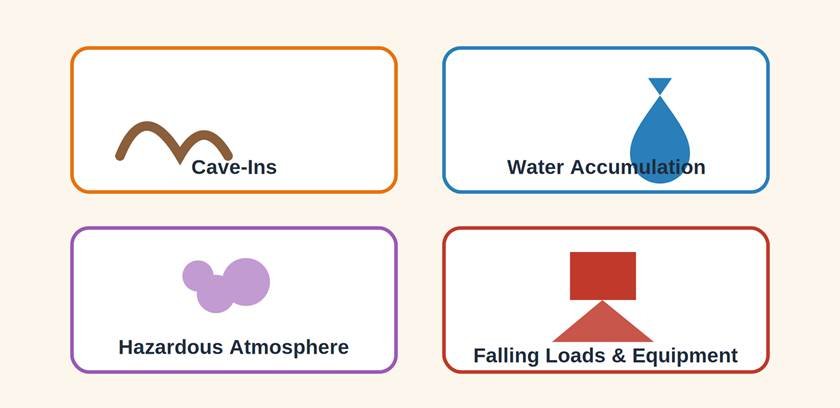
A job safety analysis for excavation work typically identifies four recurring hazard categories. The first and most catastrophic is a cave-in: soil that looks solid on the surface can already be fractured beneath, especially after rain, freeze-thaw cycles, or nearby vibration from traffic or equipment. The second is water accumulation, which both destabilizes trench walls and creates a drowning or electrocution risk if pumps or cords are involved. The third is a hazardous atmosphere — trenches can trap carbon monoxide, methane, or low-oxygen air, particularly near sewer lines, landfills, or fuel storage. The fourth is struck-by and falling-load hazards, where spoil piles, materials, or the excavator’s swinging bucket injure a worker in the trench. A thorough excavation job safety analysis walks through each of these before the first shovel goes in the ground, not after.
Soil type drives much of this risk assessment. OSHA classifies soil into Type A (most stable, such as clay), Type B (moderately stable), and Type C (least stable, including granular or previously disturbed soil). A competent person determines classification using visual assessment and manual tests before deciding how steep a slope can be or whether shoring is required, and reclassifies if conditions change — heavy rain, for instance, can turn a Type A soil into something closer to Type C almost overnight. Spoil placement matters too: OSHA requires excavated material to be kept at least two feet back from the trench edge, since a spoil pile placed too close adds weight exactly where the wall is weakest.
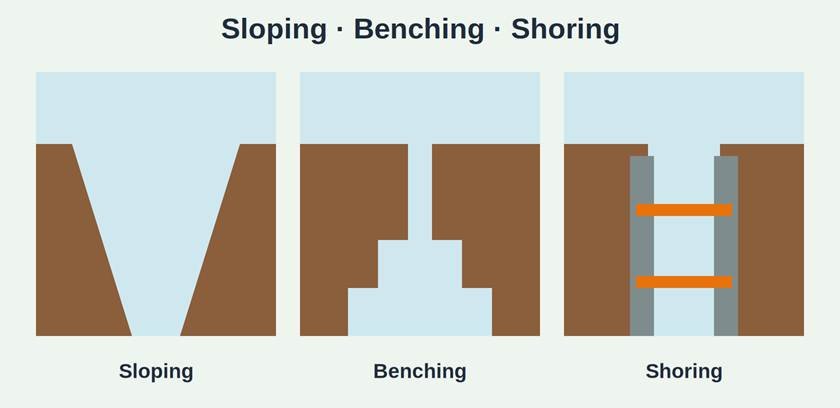
Protective Systems: Sloping, Benching, and Shoring
OSHA requires a protective system for any excavation five feet deep or greater, and three main approaches satisfy that requirement. Sloping cuts the trench walls back at an angle appropriate to the soil type, so a collapse — if it happens — spreads out rather than falling straight down on a worker. Benching creates a series of horizontal steps in the wall, which works well in more stable soils and keeps the excavation compact. Shoring installs hydraulic or timber supports directly against the trench walls to hold them in place, which is often the practical choice in confined urban excavations where sloping back the walls isn’t possible. The right system depends on soil classification (Type A, B, or C under Subpart P), depth, groundwater, and nearby vibration sources, which is why a competent person’s judgment — not a one-size-fits-all rule — drives the final decision.
Trench Boxes and Shielding Equipment
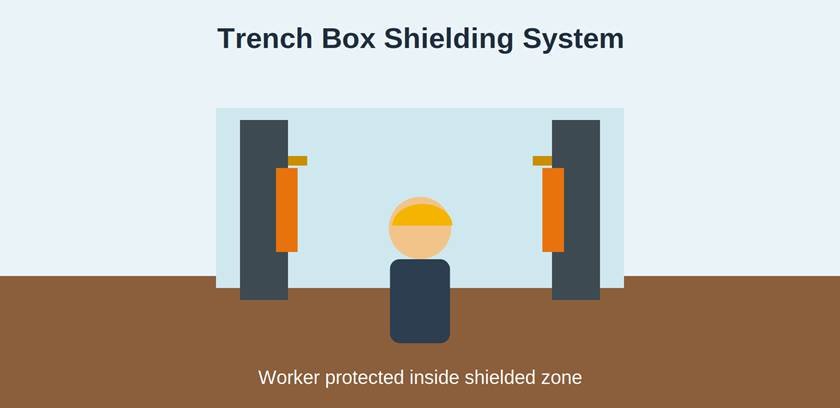
Where shoring holds the trench walls in place, a shielding system takes a different approach: it doesn’t stop the walls from moving, it protects workers if they do. A trench box (or trench shield) is a rigid steel or aluminum structure lowered into the excavation, creating a safe working chamber inside while the surrounding soil is left largely undisturbed. Trench boxes are rated by depth and soil type, and larger jobs often stack multiple boxes or use slide rail systems for very deep or long runs. Because trench boxes are heavy, specialized, and only needed for the duration of a job, most contractors turn to trench safety equipment rental rather than purchasing outright — a pattern reflected in how often people search terms like trench safety rentals or trench safety united rentals when a project is about to break ground. Rental fleets typically include aluminum and steel boxes, hydraulic shoring struts, slide rails, and ladders sized to the excavation depth.

The Competent Person and Daily Inspections
A named competent person is central to every compliant excavation. This individual must have the training to identify existing and predictable hazards, and the authority to stop work or order corrective measures immediately, without waiting for approval up the chain. OSHA requires inspections at the start of each shift, after any rainfall, and whenever conditions change that could affect stability — a nearby excavator running, a new crack in the wall, or standing water appearing overnight.
These inspections aren’t paperwork for its own sake: they are the mechanism that catches a developing hazard before it becomes a cave-in. Many of the most-watched excavation safety videos online are built around this exact walk-through, showing a competent person checking spoil placement, protective system integrity, and atmospheric readings before crews are allowed back into the trench. Training for this role typically covers soil classification, protective system selection, and hazard recognition, and many contractors refresh it annually even though OSHA does not mandate a fixed renewal cycle, simply because conditions, crews, and equipment change from job to job.
Building an Excavation Safety Plan and Job Safety Analysis
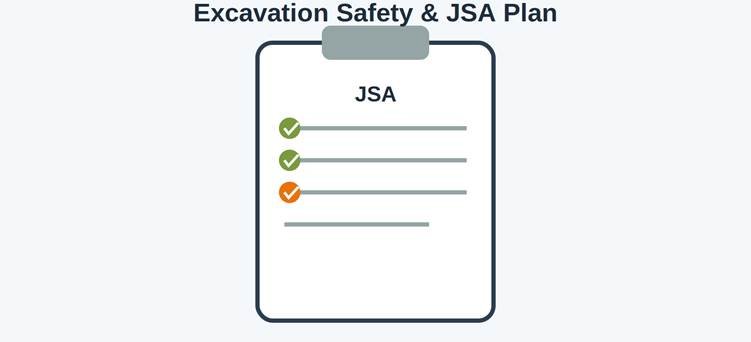
A written excavation safety plan translates the OSHA standard into a site-specific process. At minimum, it should document the competent person’s name and qualifications, the soil classification method used, the chosen protective system and its design basis, planned access and egress points, atmospheric testing procedures if applicable, and an emergency response plan in case of a cave-in or entrapment. The accompanying job safety analysis breaks the work itself into steps — excavating, installing the protective system, working inside the trench, backfilling — and lists the hazards and controls for each step individually. Together, these documents give a crew something concrete to follow rather than relying on memory, and they give supervisors a paper trail showing due diligence if an incident is ever investigated.
Access, Egress, and Atmospheric Testing
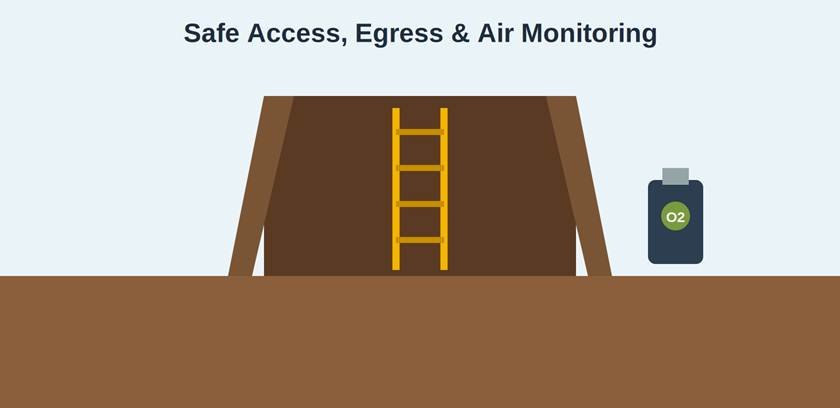
Two more Subpart P requirements round out a safe excavation. First, any trench four feet deep or greater must have a means of exit — typically a ladder, ramp, or stairway — located so that no worker has to travel more than 25 feet laterally to reach it. This sounds like a minor detail until a cave-in happens on one end of a long trench and the only ladder is 60 feet away. Second, where the atmosphere could be hazardous — near landfills, sewer systems, fuel lines, or in deep, poorly ventilated trenches — the competent person must test for oxygen content and toxic or combustible gases before entry, and continue monitoring as work proceeds. Ventilation equipment may be required if unsafe conditions are found and can’t be otherwise eliminated. These two requirements are easy to overlook on a fast-moving job site, but they consistently show up in incident reports where a worker was hurt or trapped.
Renting vs. Buying Trench Safety Equipment
Because trench boxes, hydraulic shoring, and slide rail systems represent a significant capital cost and take up yard space between jobs, most contractors — especially those who don’t excavate every week — lean on trench safety equipment rental. Rental gives access to a range of box sizes and shoring configurations matched to each project’s depth and soil type, without the burden of maintenance, recertification, or storage. It also lets a contractor scale up quickly for a large or unusual job without a long-term purchase commitment. Equipment rental companies typically deliver, and in many cases can advise on system selection based on the excavation’s depth and soil conditions, which is part of why searches like trench safety equipment rental and trench safety rentals near me spike whenever bid season picks up.
Buying still makes sense for contractors who excavate constantly and want equipment on hand without scheduling a delivery — the right call comes down to how often the equipment will actually be used.
When comparing providers, it helps to look past price alone. A good trench safety equipment rental partner will ask about trench depth, soil type, and site access before recommending a box or shoring configuration, rather than simply renting out whatever is available in the yard. Delivery lead time matters on fast-moving jobs, and some providers offer on-site training or a walkthrough of proper installation, which is valuable for crews that don’t excavate often enough to have the process memorized. Keeping a copy of the equipment’s load rating and inspection certificate on site alongside the excavation safety plan is good practice regardless of whether the box is rented or owned.
Conclusion: Building a Culture of Trench Safety
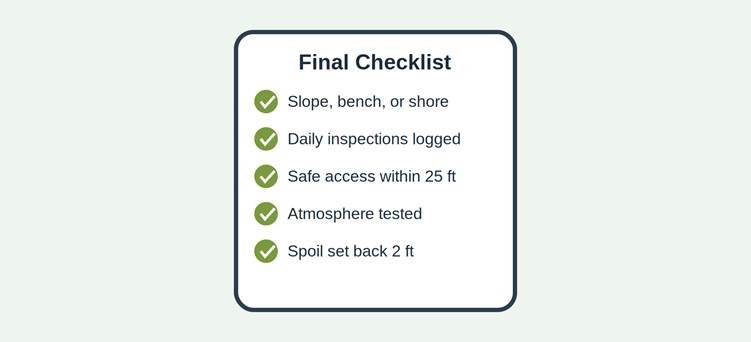
Trench and excavation safety isn’t a single checkbox — it’s a sequence of decisions made correctly, every time: classifying the soil honestly, choosing the right protective system, keeping a competent person on site and empowered to act, testing the atmosphere where it matters, and keeping egress within reach.
None of these measures are difficult on their own, and none of them are expensive compared to the cost of a cave-in. Whether a crew is reviewing a trench safety video before a toolbox talk, comparing trench safety equipment rental options for an upcoming job, or fine-tuning an excavation job safety analysis with their safety manager, the goal is the same: make sure every worker who goes below grade comes back up at the end of the shift.
This guide summarizes general OSHA excavation requirements under 29 CFR 1926 Subpart P for informational purposes and is not a substitute for site-specific engineering, a qualified competent person’s evaluation, or current regulatory text.
Here are three authoritative Resources you can link to in your blog:
- OSHA – Excavations Standard (29 CFR 1926 Subpart P)
The official OSHA excavation and trenching regulations, including protective systems and employer responsibilities. - OSHA – Trenching and Excavation Safety
Guidance on trench hazards, soil classification, protective systems, inspections, and preventing cave-ins. - NIOSH – Trenching and Excavation Safety Resources
Research-based recommendations, hazard alerts, and best practices for trench and excavation safety from the U.S. National Institute for Occupational Safety and Health (NIOSH).
Read More About


 By
By