
Table of Contents
DEFENSIVE DRIVING
Prepared July 2026
1. Introduction
Every year, millions of drivers across the world search for ways to become safer on the road, avoid traffic tickets, reduce license points, and lower their auto insurance premiums. “Defensive driving” sits at the center of all four goals. It is both a mindset and a formal, state-regulated course of instruction, and it has grown into a significant industry with dozens of providers, state-specific rules, and insurance partnerships.
This report explains what defensive driving means, why it matters from a road-safety standpoint, how courses differ from state to state and internationally (New Zealand), which providers dominate the market (including Aceable and IMPROV), and how completing a course can translate into real insurance savings with companies such as GEICO and Progressive.
2. What Is Defensive Driving?
Defensive driving is a driving philosophy and skill set aimed at reducing the risk of collisions by anticipating hazards and reacting proactively, rather than simply following the letter of traffic law. The concept was formalized in 1964 when the National Safety Council introduced the first Defensive Driving Course (DDC), and it has since been adopted worldwide, with equivalents such as New Zealand’s NZTA-approved Street Talk program.
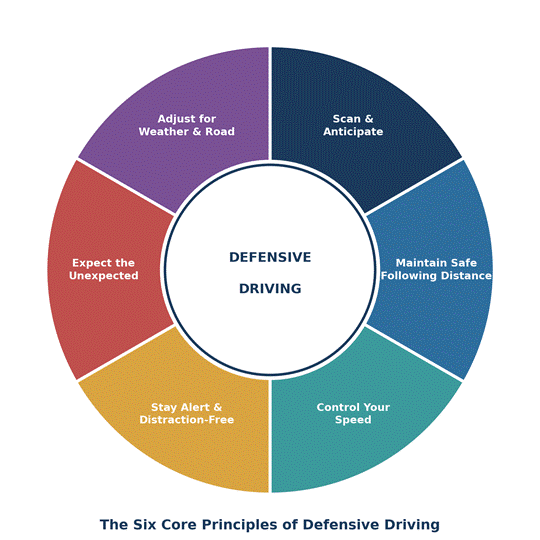
At its core, defensive driving asks a driver to assume that other road users may make mistakes and to always leave room, time, and attention to correct for those mistakes. This mindset applies to speed control, following distance, hazard scanning, distraction avoidance, and adapting to road and weather conditions.
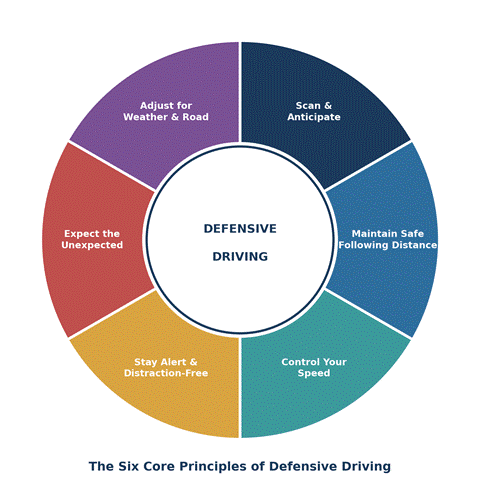
Figure 1. The six core principles that define a defensive-driving mindset.
2.1 Core Techniques in Practice
- Maintain the two-second (or longer in poor conditions) following-distance rule to allow adequate reaction time.
- Continuously scan the road ahead, mirrors, and blind spots rather than fixating on the vehicle directly in front.
- Control speed relative to conditions, not just the posted limit — slowing before curves, intersections, and reduced-visibility zones.
- Eliminate distractions: phones, eating, and other secondary tasks measurably increase reaction time.
- Assume unpredictability — do not expect other drivers or pedestrians to behave exactly as traffic law requires.
- Adjust driving behavior for rain, ice, fog, or low light, since braking distances and visibility change significantly.
3. Why Defensive Driving Matters: The Data
Government crash-data analysis consistently shows that driver behavior — not vehicle failure or road design — is the dominant factor in crashes. NHTSA research attributes the critical reason for a crash to the driver in the large majority of cases studied, with speeding, alcohol impairment, and distraction as the most common contributing behaviors.
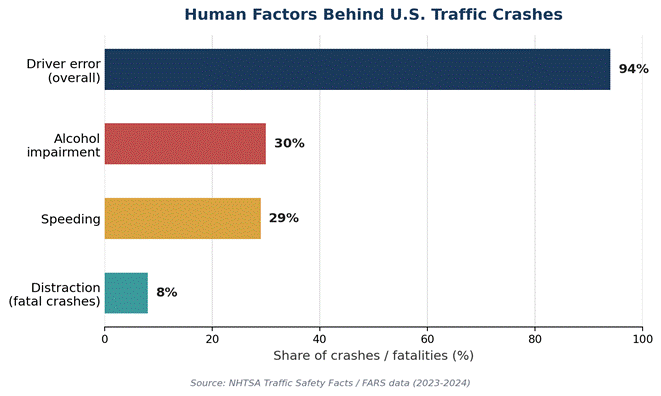
Figure 2. Approximate share of U.S. crashes and fatalities attributable to key human factors (NHTSA/FARS data, 2023-2024).
These figures underscore why defensive driving training targets exactly these behaviors: hazard anticipation counters distraction, following-distance discipline counters speeding-related rear-end collisions, and situational awareness training helps compensate for the unpredictable behavior of impaired or reckless drivers sharing the road.
4. Defensive Driving Courses by State and Region
While the underlying safety principles are universal, the legal purpose, required course length, and approving authority for a defensive driving course vary considerably by jurisdiction. The table below summarizes the requirements most frequently searched for: Texas, Florida, New York (including New York City), New Jersey, North Carolina, South Carolina, Georgia, and New Zealand.
| State / Region | Typical Course Length | Primary Purpose | Approving Authority |
| Texas | 6 hours | Ticket dismissal; insurance discount | Texas Dept. of Licensing & Regulation (TDLR) |
| Florida | 4 hrs (Basic); 8 hrs (Intermediate); 12 hrs (Advanced) | Traffic-ticket point reduction; senior insurance discount | Florida DHSMV |
| New York (incl. NYC) | 6 hours (Point & Insurance Reduction Program) | Up to 4-point reduction; ~10% insurance discount; TLC driver requirement | NYS Dept. of Motor Vehicles / NYC TLC |
| New Jersey | 6 hours | 2-point license reduction; insurance discount | NJ Motor Vehicle Commission (MVC) |
| North Carolina | Varies by provider (typically 4-8 hrs) | Insurance discount; court-ordered completion | NC DMV-approved providers |
| South Carolina | Varies by provider (typically 4-6 hrs) | Insurance discount; court/DMV requirement | SC DMV-approved providers |
| Georgia | Varies (typically 6 hrs) | Insurance discount (all ages); point mitigation | Georgia DDS-approved providers |
| New Zealand | 4 x 2-hr classroom sessions + 1 practical drive | Reduces restricted-licence hold time by up to 6 months; safer-driving skills | Waka Kotahi NZ Transport Agency (NZTA) |
Table 1. Comparative overview of defensive driving course requirements by state/region.
A few notable distinctions stand out. Texas’s 6-hour Driving Safety Course, approved by the Texas Department of Licensing and Regulation (TDLR), is almost universally used for ticket dismissal and is accepted by all Texas courts. Florida is unusual in offering tiered courses — a 4-hour Basic Driver Improvement course for minor violations, up to a 12-hour Advanced course (which includes a mandatory 24-hour break and graded essay questions) for more serious cases. New York and New Jersey both combine a point-reduction benefit (up to 4 points in NY, 2 points in NJ) with an insurance discount, while New York City additionally requires certain for-hire drivers to complete a DMV-authorized course as a Taxi and Limousine Commission (TLC) condition of licensure.
New Zealand’s model differs structurally: rather than a single online module, the NZTA-approved Defensive Driving Course (often branded “Street Talk”) combines four two-hour classroom sessions with a one-on-one practical driving assessment, and its primary incentive is a reduction in the mandatory restricted-licence holding period rather than a monetary insurance discount.
5. Popular Course Providers
The defensive driving market includes national online-education companies, legacy institutions, and regional specialists. The table below highlights providers frequently referenced by prospective students, including Aceable and IMPROV, alongside the original National Safety Council program.
| Provider | Format | Notable Feature |
| Aceable | 100% online, self-paced, mobile-friendly | State-specific courses across 18+ states; ticket dismissal & insurance-discount tracks |
| IMPROV (Defensive Driving Course) | Online, state-approved | One of the longest-running DDC brands; strong presence in TX, NY, NJ |
| American Safety Institute | Online | Wide state coverage, including Florida’s mandated driver courses |
| National Safety Council DDC | Online & in-person | Originator of the modern Defensive Driving Course (est. 1964); widely recognized by employers and insurers |
| 1SafeDriver / DriveSafeToday | Online | Focused state-specific packages (FL, TX, NJ) with fast e-certificate delivery |
| AA Driving School / Street Talk (NZ) | Classroom + practical | NZTA-approved; combines theory sessions with a one-on-one road assessment |
Table 2. Selected defensive driving course providers and their distinguishing features.
When comparing providers, drivers should verify three things before enrolling: (1) that the course is explicitly approved for their state and purpose — ticket dismissal, point reduction, or insurance discount are not always interchangeable; (2) the provider’s average completion time and any state-mandated waiting periods, such as Florida’s 24-hour break rule for its Advanced course; and (3) whether the certificate is delivered electronically, since court and insurer deadlines are often tight. Free introductory modules exist from some regional providers and driver-safety nonprofits, but a course that will count toward a legal requirement or discount almost always requires paid, state-certified enrollment.
6. Insurance Discounts for Course Completion
One of the strongest financial incentives for taking a defensive driving course is the potential auto-insurance discount. Most major insurers, including GEICO and Progressive, offer a premium reduction for policyholders who complete an approved course, though the exact percentage depends heavily on state regulation, insurer policy, and sometimes driver age.
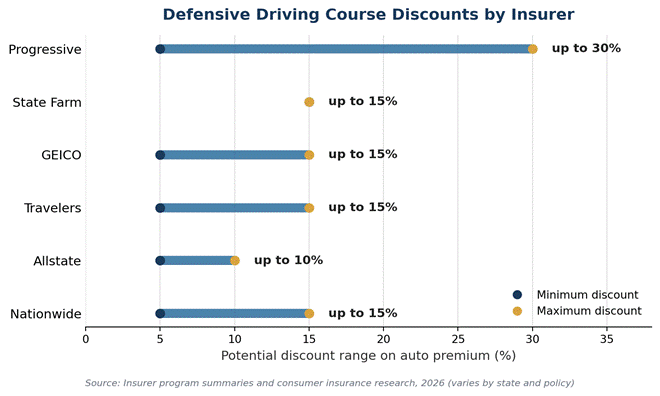
Figure 3. Approximate discount ranges offered by major U.S. auto insurers for defensive driving course completion.
| Insurer | Typical Discount | Notes |
| Progressive | 5% – 30% | Widest advertised range; varies sharply by state; can stack with telematics programs |
| State Farm | ~15% | Consistent flat-rate discount where offered |
| GEICO | 5% – 15% | Higher end (10-15%) often reserved for drivers 50+, depending on state |
| Travelers | 5% – 15% | Discount duration commonly 3 years from certificate date |
| Allstate | 5% – 10% | Generally the most conservative discount among major carriers |
| Nationwide | 5% – 15% | Eligibility and percentage vary significantly by state |
Table 3. Summary of typical defensive driving discounts by insurer (figures are illustrative averages; actual savings vary by state and policy).
Several practical points apply across insurers. First, discounts typically remain active for about three years from the certificate date, after which the course must be retaken to keep the savings — Washington State is a notable exception at two years. Second, some insurers restrict the larger discount tiers to drivers aged 50 or older, while others, such as Georgia’s approved program, extend the discount to all ages. Third, a course fee of roughly $20-$100 is typically recovered within the first one to two months of discounted premiums, making the exercise close to self-funding even before factoring in the safety benefit.
7. Choosing the Right Course
- Confirm your purpose first: ticket dismissal, point reduction, insurance discount, or a court/DMV mandate may each require a different course type.
- Check state approval status directly with the relevant authority (e.g., TDLR in Texas, DHSMV in Florida, MVC in New Jersey, NZTA in New Zealand) rather than relying solely on a provider’s marketing claims.
- Compare course length and format — online, self-paced courses suit most insurance-discount and minor-ticket needs, while court-ordered or advanced courses may require in-person or proctored components.
- Ask your insurer in advance which providers and courses they accept, since not all state-approved courses automatically qualify for every insurer’s discount.
- Keep a copy of your completion certificate and calendar the discount’s expiration date so you can renew before losing the savings.
8. 15 Proven Safety Techniques Every Driver Must Know
Practice Defensive Driving Every Time You Drive
- Always Wear Your Seat Belt
- Maintain a Safe Following Distance
- Stay Focused and Avoid Distractions
- Obey Speed Limits at All Times
- Scan the Road Ahead Continuously
- Anticipate Other Drivers’ Actions
- Inspect Your Vehicle Before Every Trip
- Adjust Your Driving to Weather Conditions
- Never Drive Under the Influence
- Manage Driver Fatigue Effectively
- Use Mirrors and Blind Spot Checks Frequently
- Follow the Three-Second Rule
- Avoid Aggressive Driving and Road Rage
- Plan Safe Routes and Emergency Alternatives
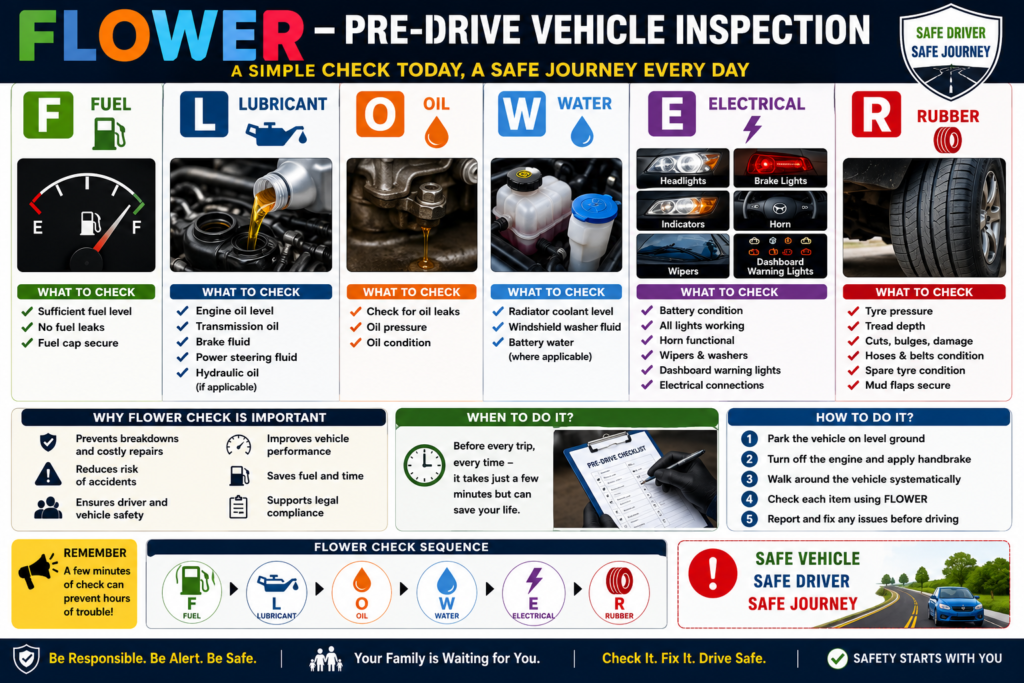
9. FLOWER Check – Your First step to a Safe Journey
8. Conclusion
Defensive driving is both a safety discipline and a practical financial decision. The underlying skills — scanning for hazards, maintaining following distance, controlling speed, and eliminating distraction — directly target the behaviors that NHTSA data identifies as the leading causes of crashes. At the same time, the modern course landscape, shaped by state regulators and reinforced by insurer discount programs from companies like GEICO and Progressive, gives drivers a clear, tangible incentive to complete formal training beyond what they learned when first licensed.
Whether the goal is dismissing a ticket in Texas, reducing points in New York or New Jersey, qualifying for a senior discount in Florida, shortening a restricted licence period in New Zealand, or simply becoming a safer driver, the research is consistent: structured defensive driving education measurably reduces risk and, in most cases, measurably reduces cost.


 By
By