
Table of Contents
HSE preparedness in storage areas is often discussed as if it simply means having fire extinguishers, safety signs, PPE and an emergency telephone number displayed on the wall.
In my view, that is where the problem starts.
A storage area is not simply a place where materials are kept until somebody needs them. It is a temporary concentration of hazards.
The material may be a flammable liquid, toxic chemical, corrosive substance, oxidizer, compressed gas, LPG cylinder, combustible solid, reactive chemical, hazardous waste or even an apparently harmless product that becomes dangerous when exposed to heat, water, another chemical or an ignition source.
The risk changes further when we start moving those materials.
A drum being transported by forklift, a cylinder being moved with a trolley, a chemical being transferred from one container to another, or a liquid being pumped into a process can introduce hazards that did not exist when the material was sitting quietly on a rack.
After years of looking at HSE systems, I have learned one simple lesson:
The safest storage area is not the one with the most safety equipment. It is the one where hazards have been understood before something goes wrong.
This is why HSE preparedness in storage areas needs to begin before the material arrives at the warehouse.
It begins with classification, compatibility, quantity, location, container integrity, ventilation, ignition control, access, handling methods, emergency planning and competent people.
And importantly, the emergency plan should not be written after the emergency.
It should be written while everyone is still safe.
Why Storage Areas Deserve Serious HSE Attention
Storage areas can contain large quantities of hazardous materials in relatively small spaces.
This creates the possibility of escalation.
One leaking container can become a spill.
A spill can produce vapour.
Vapour can travel to an ignition source.
An ignition source can produce a fire.
A fire can heat neighbouring containers.
Those containers can fail, releasing more material.
The original incident can therefore become a major emergency.
This escalation is exactly why storage safety should be treated as a process rather than a housekeeping activity.
The U.S. Chemical Safety and Hazard Investigation Board (CSB) has investigated nearly 180 chemical incidents over its 25-year history and has issued more than 1,000 recommendations related to chemical safety.
That history tells us something important: major incidents are rarely about one isolated mistake.
They are usually the result of several barriers failing together.
What Can Be Stored in an Industrial Storage Area?
Before deciding where something should be stored, we need to understand what it is.
A practical storage classification may include:
| Material type | Examples | Principal hazards | Key storage concerns |
|---|---|---|---|
| Flammable liquids | Solvents, fuels, thinners | Fire, vapour explosion | Ignition control, ventilation, approved containers |
| Flammable gases | LPG, hydrogen, acetylene | Fire, explosion, pressure | Ventilation, cylinder security, segregation |
| Toxic gases | Chlorine, ammonia | Inhalation, toxic exposure | Detection, ventilation, emergency isolation |
| Corrosives | Acids, alkalis | Burns, corrosion, toxic reaction | Compatible containment and segregation |
| Oxidizers | Peroxides, chlorates, pool chemicals | Fire, decomposition, reaction | Strict compatibility controls |
| Combustible solids | Plastics, paper, wood | Fire, smoke, dust | Fire protection and housekeeping |
| Reactive chemicals | Peroxides, reactive intermediates | Explosion, decomposition | Temperature and compatibility control |
| Toxic solids/liquids | Pesticides, certain chemicals | Poisoning, environmental contamination | Secure storage and exposure controls |
| Compressed gases | Oxygen, nitrogen, CO₂ | Pressure, asphyxiation, cylinder failure | Secure upright storage and ventilation |
| Hazardous waste | Used solvents, contaminated materials | Fire, toxic exposure, pollution | Identification, segregation and containment |
This classification should not be based merely on the product name.
The Safety Data Sheet (SDS), supplier information, applicable legislation and the actual hazard classification should be reviewed.
The United Nations dangerous-goods framework similarly places importance on classification, packaging, marking, labelling and documentation for dangerous goods.
HSE Preparedness in Storage Areas Starts With Chemical Compatibility
One of the most important principles in storage safety is:
Do not store chemicals together simply because they physically fit together.
They need to be compatible.
An acid and an incompatible chemical may react.
An oxidizer can intensify combustion.
Water-reactive material can create a dangerous reaction when exposed to water.
An oxidizing chemical stored beside combustible material can create a serious fire scenario.
The 2024 Bio-Lab warehouse incident in Conyers, Georgia, provides a powerful real-world example.
According to the CSB’s final investigation released in July 2026, water from a corroded sprinkler component contacted reactive pool-treatment chemicals. The resulting decomposition reaction generated heat, off-gassing and multiple fires, producing toxic smoke containing chlorine, hydrogen chloride and bromine. Approximately 17,000 people were reportedly evacuated and about 90,000 people were advised to shelter in place.
This incident demonstrates a lesson that every warehouse HSE professional should remember:
A fire protection system can itself become part of a chemical reaction scenario if the stored materials and extinguishing medium have not been properly assessed.
That does not mean sprinklers are inherently unsafe.
It means fire protection must be engineered around the materials actually stored.
The CSB subsequently recommended that the company develop corporate standards for storage configuration and handling of bulk pool-treatment chemicals and ensure compliance with relevant hazardous-material and sprinkler standards.
How to Apply Chemical Segregation
A good storage system should have a compatibility matrix.
For example:
| Hazard group | Typical separation consideration |
| Flammable liquids | Keep away from ignition sources and incompatible oxidizers |
| Oxidizers | Separate from fuels, combustibles and incompatible chemicals |
| Acids | Segregate from incompatible alkalis and reactive substances |
| Alkalis | Segregate from incompatible acids |
| Water-reactive chemicals | Protect from water sources and incompatible materials |
| Toxic chemicals | Secure and segregate according to hazard and exposure potential |
| Compressed gases | Separate incompatible gases and protect cylinders from damage |
| LPG/flammable gases | Locate in suitable, ventilated areas away from ignition sources |
| Hazardous waste | Keep identified and segregated according to compatibility |
The exact separation distances and storage arrangements must come from the applicable regulation, fire code, SDS, engineering assessment and local authority requirements.
A generic table should never replace a compatibility assessment.
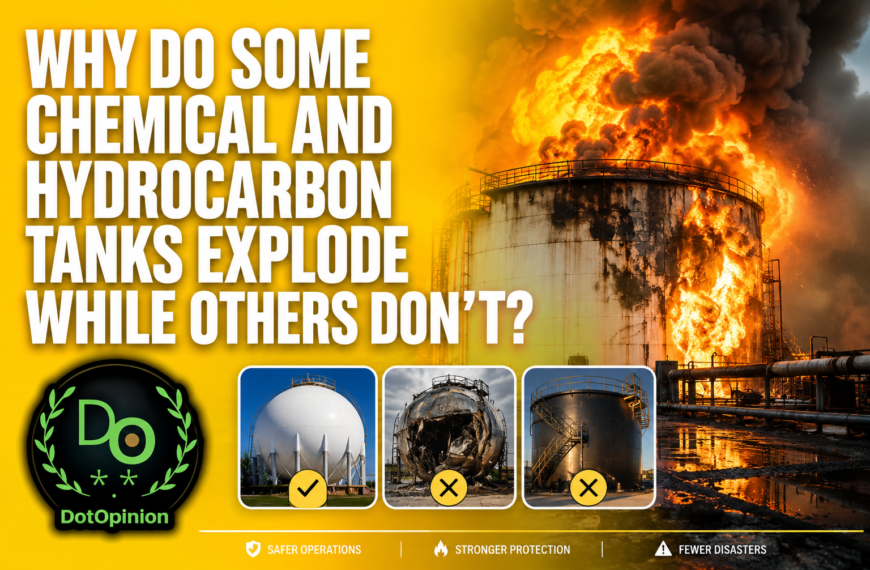
Storage of Flammable Liquids
Read More About Flammable Liquids
Flammable liquids require particular attention because the liquid itself may not be what burns.
In many situations, the vapour is the immediate fire and explosion concern.
OSHA’s requirements for flammable liquids address approved containers, storage cabinets, ventilation, aisle access, spill containment and fire protection.
For example, OSHA requires flammable liquids to be stored in appropriate tanks or containers and establishes quantity limits and requirements for approved storage cabinets. OSHA also emphasizes that flammable liquids should not obstruct exits or normal escape routes.
From a practical HSE perspective, I would look at:
- Container integrity
- Flash point and hazard classification
- Quantity stored
- Ignition sources
- Electrical classification
- Ventilation
- Static electricity
- Bonding and grounding where required
- Spill containment
- Fire protection
- Emergency access
- Separation from incompatible materials
- Housekeeping
- Smoking and hot-work controls
- Transfer procedures
One common mistake is allowing the storage area to gradually become an unofficial workshop.
A few drums become a shelf.
The shelf becomes a temporary maintenance area.
Then somebody performs grinding nearby.
That is how risk quietly increases.
Compressed Gas Cylinders: Small Footprint, Serious Consequence
Gas cylinders are another storage hazard that is frequently underestimated.
A cylinder may contain oxygen, nitrogen, hydrogen, LPG, acetylene, carbon dioxide, ammonia, chlorine or another gas.
The cylinder is simultaneously:
- A pressure vessel.
- A source of potentially hazardous material.
- A physical object capable of causing injury if it falls.
- Potentially a fire or explosion hazard.
OSHA guidance requires compressed gas cylinders to be secured against falling and stored in well-protected, dry and well-ventilated locations. Cylinders should also be kept away from areas where they can be damaged or obstruct passage.
Practical controls include:
- Store cylinders upright where required.
- Secure cylinders using suitable chains, straps or racks.
- Protect valves.
- Keep incompatible gases appropriately segregated.
- Prevent vehicle and forklift impact.
- Keep cylinders away from heat sources.
- Maintain adequate ventilation.
- Identify full, empty and out-of-service cylinders.
- Inspect cylinders before handling.
- Use suitable cylinder trolleys.
- Do not drag or roll cylinders unnecessarily.
- Ensure valve protection is installed where required.
- Restrict access to trained personnel.
A cylinder should never be treated like an ordinary piece of warehouse stock.
Handling and Transfer of Hazardous Materials
Storage is only one part of the risk.
Transfer can be even more hazardous because the material is being disturbed.
Examples include:
- Drum-to-drum transfer
- Tank-to-tank transfer
- Pumping flammable liquids
- Loading and unloading tankers
- Moving gas cylinders
- Forklift movement of chemical containers
- Manual handling of chemical containers
- Transfer of hazardous waste
- Connection and disconnection of hoses
- Decanting chemicals
- Loading dangerous goods for transportation
The basic principle should be:
The transfer method must be designed around the hazard.
A corrosive chemical should not be transferred using incompatible equipment.
A flammable liquid should not be casually poured into an open container where vapours can accumulate.
A pressurized gas cylinder should not be transported without appropriate equipment.
Dangerous goods should be handled by trained personnel, and the UNECE CTU Code guidance emphasizes trained handling, supervision, damaged-package controls, suitable PPE and emergency procedures.
The Five Questions I Ask Before Hazardous Material Transfer
Before allowing a transfer operation, ask:
1. What exactly are we transferring?
Know the material.
Do not rely on a verbal description such as “solvent,” “chemical” or “gas.”
Identify the exact product and hazard classification.
2. What can go wrong?
Consider:
- Leakage
- Hose failure
- Container failure
- Static ignition
- Overfilling
- Wrong connection
- Chemical incompatibility
- Human exposure
- Forklift collision
- Loss of containment
3. What prevents it?
Identify engineering and administrative controls.
4. What happens if the control fails?
This is where emergency preparedness starts.
5. Can the emergency team actually respond?
A beautifully written emergency procedure is useless if nobody knows where the spill kit is.
Possible Emergency Situations in Storage Areas
A competent emergency preparedness assessment should consider more than fire.
| Emergency | Possible initiating event | Potential consequence | Immediate priority |
| Chemical spill | Container damage | Exposure/environmental contamination | Isolate, identify, contain |
| Toxic gas release | Cylinder/valve failure | Poisoning/asphyxiation | Evacuate, isolate, specialist response |
| Flammable vapour release | Leak during transfer | Fire/explosion | Remove ignition sources if safe, evacuate |
| Warehouse fire | Ignition of stored material | Fire, smoke, escalation | Alarm, evacuation, emergency services |
| Chemical reaction | Incompatible materials contact | Heat, gas, explosion | Isolate area and avoid unsafe intervention |
| Cylinder failure | Heat/impact/pressure failure | Projectile/pressure event | Evacuate and isolate |
| Forklift collision | Vehicle impact | Spill/fire/injury | Stop movement, isolate area |
| Flood/water ingress | Heavy rain/flooding | Chemical reaction/release | Protect materials where safe |
| Power failure | Electrical system failure | Loss of ventilation/detection | Assess hazardous conditions |
| Natural disaster | Earthquake/storm | Container damage | Inspect before re-entry |
| Structural collapse | Fire/explosion/overloading | Entrapment | Evacuate and restrict access |
| Environmental release | Spill reaches drain/soil | Pollution | Stop pathway if safe and notify |
| Medical exposure | Splash/inhalation | Injury/poisoning | First aid/decontamination/emergency medical response |
The table is not a substitute for a site-specific emergency plan.
It is a starting point for the hazard identification process.
HSE Preparedness in Storage Areas Requires Emergency Scenarios
A useful emergency plan should answer a simple question:
“If this happens at 2:00 a.m., what exactly will we do?”
Not:
“Employees should take appropriate action.”
That sentence belongs in a generic policy.
An operational emergency procedure needs names, responsibilities, communication methods, isolation points, evacuation routes, muster points, emergency contacts, equipment locations and escalation criteria.
ISO identifies emergency preparedness as an important part of occupational health and safety management, with ISO 45001 Clause 8.2 providing a framework for identifying potential emergencies and developing response arrangements.
For environmental emergencies, ISO 14001 also emphasizes preparing for and responding to potential emergency situations, testing response actions where practicable, reviewing them and providing relevant training.
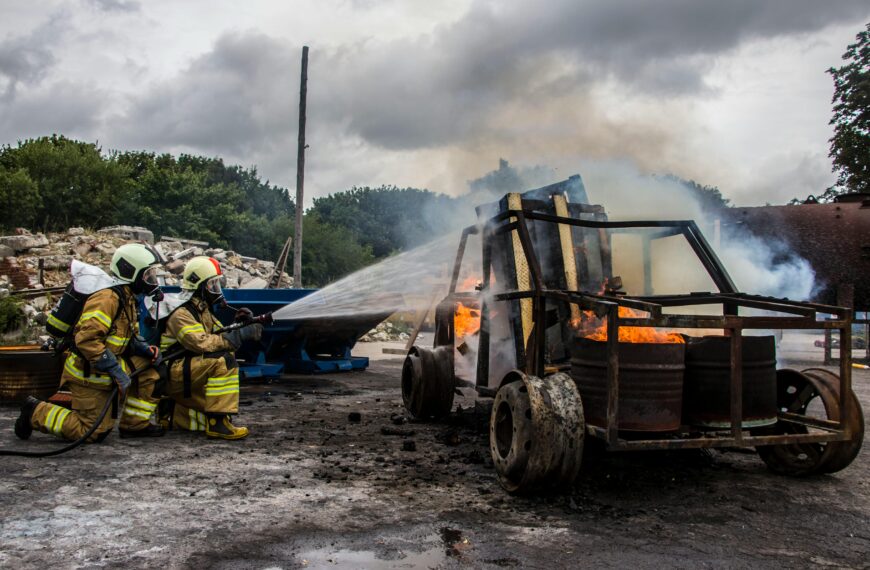
Emergency Response: Do Not Turn Workers Into Firefighters
Read More About Emergency Response Plan
One of the most dangerous attitudes in industrial safety is:
“We can handle this ourselves.”
Sometimes the first person discovering an incident can safely take limited action.
But there must be a defined boundary.
For example:
A trained employee may be able to stop a small leak if the container is safely accessible and the procedure specifically permits it.
The same employee should not approach an unknown toxic gas cloud simply because a valve appears accessible.
Similarly, a small incipient fire may fall within a trained employee’s response capability, while a rapidly developing warehouse fire requires evacuation and professional emergency response.
The emergency plan should clearly define:
- When to raise the alarm
- When to evacuate
- When to shelter in place
- When to isolate equipment
- When to call emergency services
- Who can attempt spill containment
- Who can use emergency equipment
- When PPE is mandatory
- When respiratory protection is required
- When specialist chemical response is required
- When the area must remain isolated
Learning From Real Industrial Incidents
Real incidents are often better teachers than theoretical safety slogans.
Bio-Lab Conyers Chemical Fire
The Bio-Lab incident is particularly relevant to storage professionals because the incident occurred inside a storage warehouse.
The CSB’s final report states that water from a failed/corroded sprinkler component contacted reactive chemicals, initiating decomposition, heat generation, off-gassing and fires. The event ultimately resulted in a major toxic smoke plume and extensive community emergency measures.
The reported impact included approximately:
| Impact | Reported figure |
| Community evacuation | ~17,000 people |
| Shelter-in-place advice | ~90,000 people |
| Warehouse | Destroyed |
| Emergency warnings | Continued for weeks |
The important lesson is not simply “chemicals caught fire.”
The deeper lesson is:
Storage configuration, compatibility, fire protection, emergency response and community impact are connected.
Hwaseong Lithium Battery Fire
The June 2024 Aricell battery factory fire in Hwaseong, South Korea, also demonstrates how quickly a storage-related fire involving high-energy materials can become catastrophic.
Reuters reported that the fire followed multiple lithium battery explosions and killed 22 workers in its initial reporting; subsequent reporting cited a death toll of 23.
The incident highlighted issues around rapidly spreading fire, toxic gases, worker familiarity with the facility and emergency evacuation.
For an HSE professional, the lesson is broader than lithium batteries.
Whenever a storage area contains materials that can generate intense heat, toxic combustion products or rapid fire spread, the emergency plan must consider the behavior of the material—not merely the building.
What the Incident Data Tells Us
The CSB’s publicly available accident reporting information provides another important perspective.
As of April 17, 2025, CSB said its Accidental Release Reporting Rule data covered 495 chemical incidents involving fatalities at 76 facilities, serious injuries at 268 facilities and substantial property damage at 232 facilities.
These figures should not be interpreted as a complete global database of chemical incidents.
They do, however, demonstrate that chemical releases remain a significant industrial safety issue.
The practical HSE lesson is this:
Preparedness should be based on credible scenarios, not optimism.
Storage Area Emergency Equipment
Emergency equipment should be selected according to the hazards present.
Potential equipment includes:
- Suitable fire extinguishers
- Fire hose systems
- Fixed fire protection
- Spill kits
- Drain covers
- Absorbent materials
- Chemical-resistant PPE
- Emergency showers
- Eyewash stations
- Gas detection
- Emergency lighting
- Alarm systems
- Communication equipment
- First-aid equipment
- Breathing apparatus for specialist responders
- Emergency isolation equipment
- Rescue equipment where appropriate
But equipment alone does not equal preparedness.
A spill kit that nobody knows how to use is decoration.
An emergency shower blocked by stored drums is not an emergency control.
A fire extinguisher hidden behind pallets is not accessible protection.
A gas detector with no calibration or maintenance program provides false confidence.
Storage Racking and Cabinet Integrity: The Structure Must Be Able to Carry the Risk
One area that is frequently overlooked during storage-area inspections is the condition and load-bearing capacity of the storage system itself.
A chemical may be perfectly labelled and correctly segregated, but if the rack holding it is overloaded, corroded, damaged by forklifts or incorrectly assembled, the storage system is still unsafe.
In my experience, storage-rack inspections should therefore be treated as an integral part of the HSE management system rather than as a maintenance activity.
Every rack should have clearly identifiable safe working load information or load-rating information appropriate to its design. The maximum permissible load should never be estimated by the warehouse operator.
The load-bearing capacity should be verified against the manufacturer’s design information, engineering documentation and the actual configuration of the rack.
Where the configuration is changed—such as changing beam levels, replacing components, increasing pallet loads or modifying the rack—the capacity should be reassessed before the modified arrangement is placed into service.
Recommended Racking Inspection System
A robust system should contain several levels of inspection:
| Inspection level | Typical frequency | Responsible person | Main purpose |
|---|---|---|---|
| Pre-use / routine visual check | Before use or as defined by risk assessment | Warehouse personnel | Identify obvious damage, instability or unsafe loading |
| Regular documented inspection | Weekly or other risk-based interval | Trained responsible person | Identify damage, displacement, corrosion and defects |
| Expert inspection | At least every 12 months as a good-practice benchmark | Competent/technically qualified person | Detailed assessment of structural integrity and safety |
| Post-incident inspection | Immediately after significant impact/damage | Competent person | Determine whether the rack remains safe |
| Post-modification inspection | Before returning to service | Competent person/engineer | Verify the modified configuration |
The UK HSE recommends immediate reporting of significant damage, regular visual inspections and expert inspections by a technically competent person at intervals of not more than 12 months. HSE also emphasizes that rack damage can reduce its load-carrying capacity.
A third-party or independent competent inspection is particularly valuable because it provides an objective assessment rather than allowing the person responsible for the storage operation to judge their own system.
The inspection should examine, where applicable:
- Uprights and frames
- Beams
- Beam-to-upright connections
- Bracing
- Base plates
- Anchors
- Rack protection
- Corrosion
- Deformation
- Forklift impact damage
- Missing or damaged components
- Pallet condition
- Load distribution
- Excessive deflection
- Stability
- Floor condition
- Safe working load information
- Unauthorized modifications
Any critical structural damage should result in the affected rack being isolated and unloaded as necessary until a competent person confirms that it is safe. This is particularly important after forklift impact.
A rack should never be considered safe merely because it has not collapsed.
The purpose of inspection is to identify deterioration before collapse occurs.
Material Classification Must Go Beyond Hazard Labels
Another mistake I frequently see in storage areas is classification based only on the chemical name or hazard pictogram.
A proper storage system should consider several characteristics simultaneously.
Materials should be classified according to:
Hazard vulnerability + compatibility + physical condition + weight + toxicity + accessibility + storage quantity + fire behavior + environmental consequence.
For example, two materials may both be classified as hazardous but require completely different storage arrangements.
One may be highly toxic but non-flammable.
Another may be relatively low in toxicity but extremely flammable.
One may be stable under normal conditions.
Another may react violently with water or another chemical.
Therefore, the storage arrangement should reflect the actual risk profile.
A Practical Storage Classification Matrix
| Factor | What should be considered? | Storage implication |
|---|---|---|
| Chemical compatibility | Acid, alkali, oxidizer, reducer, water-reactive etc. | Segregate incompatible materials |
| Toxicity | Acute toxicity, chronic toxicity, inhalation hazard | Restricted access and appropriate controls |
| Flammability | Flash point, vapour generation, ignition potential | Fire protection and ignition control |
| Reactivity | Potential for decomposition or chemical reaction | Temperature and compatibility control |
| Physical state | Solid, liquid, gas, compressed gas | Appropriate storage system |
| Weight | Individual container and total rack load | Correct rack/cabinet capacity |
| Container condition | Corrosion, leakage, deformation, damage | Remove defective containers from service |
| Accessibility | Frequency and difficulty of access | Store frequently handled materials appropriately |
| Quantity | Maximum inventory and credible release | Storage capacity and emergency planning |
| Environmental hazard | Soil/water contamination potential | Secondary containment and drainage controls |
| Fire behavior | Combustible, oxidizing, explosive or toxic combustion products | Appropriate fire detection/protection |
| Stability | Sensitivity to heat, sunlight, moisture or vibration | Environmental controls |
| Emergency consequence | Likely impact of release | Location, isolation and response planning |
The principle should be simple:
Store materials according to their risk characteristics, not simply according to the space available.
Chemical labels and Safety Data Sheets should be used as part of this classification process. OSHA’s Hazard Communication Standard requires chemical hazards to be classified and communicated through labels, safety data sheets and employee training. SDS information specifically includes firefighting measures, accidental-release measures, handling/storage requirements and incompatibilities.
Storage Height and Weight Distribution
Weight is another important consideration.
Heavy containers should not automatically be stored at the highest available level simply because the lower rack positions are occupied.
The storage arrangement should consider:
- Weight of individual containers
- Total rack load
- Load distribution
- Centre of gravity
- Pallet capacity
- Rack beam capacity
- Floor loading
- Frequency of handling
- Consequence of falling material
- Chemical hazard if the container falls
As a practical principle, heavy, unstable or high-consequence materials should generally be positioned to minimize the potential for falling objects and manual-handling injuries, while always following the rack manufacturer’s design and applicable standards.
A 50 kg container of a relatively harmless product and a 50 kg container of a highly toxic or corrosive chemical do not have the same consequence if dropped.
Therefore, weight alone is not enough.
Weight multiplied by hazard consequence should influence storage location.
Accessibility Is Also a Safety Classification
Accessibility should be deliberately controlled.
Not every chemical needs to be immediately accessible to every worker.
High-risk materials may require:
- Restricted access
- Locked cabinets
- Authorized-person access
- Inventory control
- Key/card control
- CCTV where appropriate
- Controlled issue and return
- Specific handling procedures
At the same time, emergency equipment must have the opposite characteristic.
Emergency exits, fire extinguishers, emergency showers, eyewash stations, spill kits, alarms and emergency isolation points must remain immediately accessible and unobstructed.
This distinction is important:
Hazardous materials may require controlled access; emergency controls require unrestricted emergency access.
Fire Detection and Fire Protection in Storage Areas
Fire protection should never be selected simply by installing the same extinguisher or detector throughout the facility.
The fire protection strategy should be based on:
- Material classification
- Quantity
- Storage arrangement
- Ceiling height
- Rack height
- Fire load
- Packaging
- Vapour characteristics
- Potential fire growth rate
- Smoke production
- Toxic combustion products
- Electrical equipment
- Building construction
- Ventilation
- Local fire code
- Insurance requirements
- Fire engineering assessment
Fire Detection
Depending on the storage environment and fire risk assessment, detection may include:
- Smoke detectors
- Heat detectors
- Flame detectors
- Combustible-gas detectors
- Toxic-gas detectors
- Aspirating smoke detection
- Beam-type smoke detection
- Multi-criteria detection
The correct detector depends on the expected fire or release scenario.
For example, a combustible-gas release requires a different detection philosophy from a conventional warehouse fire.
A toxic gas storage area may require fixed gas detection appropriate to the specific gas.
A dusty or dirty environment may make conventional smoke detection unsuitable and require an alternative technology.
High-rack storage may also require careful consideration of detector location and fire development because smoke and heat behavior can differ significantly from a conventional room.
Detection design should therefore be performed by a competent fire-protection professional using the applicable fire code, engineering standards and site-specific risk assessment.
Selecting the Correct Fire Extinguisher
There is no single “best fire extinguisher” for every storage area.
The extinguisher must correspond to the fire hazard.
| Fire hazard | Typical extinguisher approach* |
|---|---|
| Ordinary combustibles such as paper, wood and some packaging | Water, foam or suitable multipurpose agent |
| Flammable liquids | Foam, dry chemical or other agent specifically rated for the hazard |
| Energized electrical equipment | Non-conductive agent such as CO₂ or dry chemical, depending on the application |
| Combustible metals | Special Class D extinguishing agent |
| Cooking oils/fats | Wet chemical |
| Flammable gases | Appropriate dry chemical or other approved system, combined with gas isolation where possible |
*The exact extinguisher type, rating and quantity must be determined by the applicable fire code, hazard assessment and manufacturer’s listing.
OSHA requires portable extinguishers to be selected and distributed according to the anticipated fire type, size and degree of hazard. For employee-use extinguishers, OSHA specifies a maximum travel distance of 75 ft (22.9 m) for Class A hazards and 50 ft (15.2 m) for Class B hazards. Class C placement follows the underlying Class A or B hazard, while Class D hazards require appropriate extinguishing agents where applicable.
This is an important distinction:
Extinguisher spacing is measured by travel distance to the hazard, not simply by placing extinguishers at arbitrary equal distances along a wall.
Extinguishers should also be:
- Clearly identified
- Readily accessible
- Unobstructed
- Appropriate for the hazard
- Properly mounted where required
- Inspected and maintained
- Within their service/inspection requirements
- Supported by worker training where employee use is expected
Emergency Eyewash and Safety Showers
Where workers may be exposed to injurious corrosive materials, emergency flushing facilities are a critical control.
An eyewash should not be treated as an ordinary plumbing fixture.
It should be specifically designed and maintained for emergency use.
Where there is potential for significant body exposure to corrosive material, an emergency safety shower may also be required.
The OSHA requirement is that suitable facilities for quick drenching or flushing of the eyes and body be provided where employees may be exposed to injurious corrosive materials. OSHA refers employers to ANSI Z358.1 for detailed guidance on emergency eyewash and shower equipment.
The location should allow an exposed worker to reach the equipment rapidly without encountering doors, obstacles or additional hazards.
OSHA interpretation has historically referred to approximately 10 feet of unobstructed travel distance for highly corrosive hazards based on ANSI guidance, although the applicable current standard and site risk assessment should be verified for the specific facility.
Emergency eyewash/shower provisions should include:
- Suitable location
- Unobstructed access
- Clearly visible identification
- Adequate flushing capacity
- Suitable water quality
- Temperature suitable for emergency use
- Regular inspection
- Functional testing
- Protection against contamination/freezing where applicable
- Appropriate drainage
- Worker awareness and training
Where the chemical hazard requires both eye and body flushing, provide the appropriate combination of eyewash and emergency shower.
A small portable eyewash bottle should not automatically be considered an equivalent replacement for a properly designed emergency eyewash station where a permanent facility is required.
First-Aid Arrangements for Storage Areas
First-aid arrangements should reflect the actual hazards rather than simply placing a generic first-aid box in the warehouse office.
The assessment should consider:
- Number of workers
- Shift pattern
- Distance from medical facilities
- Chemical exposure potential
- Burns
- Cuts and lacerations
- Eye injuries
- Inhalation exposure
- Crushing injuries
- Manual-handling injuries
- Forklift incidents
- Chemical splash
- Fire-related injuries
A storage facility handling corrosives should have appropriate arrangements for chemical splash emergencies.
A facility handling toxic gases should consider the emergency medical consequences of inhalation exposure.
A facility handling flammable liquids should consider burns, smoke inhalation and fire-related injuries.
The first-aid arrangement should therefore be linked directly to the risk assessment and emergency response plan.
Spill Response Equipment
A storage area containing hazardous liquids should have a spill response strategy appropriate to the chemicals stored.
The spill kit may need:
- Absorbent pads
- Absorbent socks
- Granular absorbent
- Chemical-resistant gloves
- Chemical-resistant goggles
- Face protection
- Protective clothing
- Waste bags/containers
- Drain covers
- Chemical-specific neutralizing agents where appropriate
- Non-sparking tools where required
- Warning/barrier tape
- Suitable disposal containers
However, one generic spill kit should not be assumed to be suitable for every chemical.
The SDS should be consulted before selecting containment and cleanup materials.
Some chemicals may react with common absorbents or water.
Others may require specialist emergency response.
Workers should never be instructed to clean an unidentified chemical spill simply because a spill kit is nearby.
Emergency Equipment Location: Accessibility Is a Design Requirement
One of the easiest ways to test a storage area’s preparedness is to walk through it and ask:
“Can I reach the emergency equipment immediately?”
Check whether:
- Fire extinguishers are blocked by pallets.
- Eyewash stations are hidden behind drums.
- Emergency showers are inaccessible.
- Spill kits are locked away.
- Emergency exits are obstructed.
- Gas isolation valves are inaccessible.
- First-aid kits are too far away.
- Emergency telephones cannot be reached.
- Alarm call points are blocked.
- Emergency lighting is inadequate.
The best emergency equipment is useless if the person who needs it cannot reach it.
A Storage Area Should Have a Clearly Defined Emergency Zone
For higher-risk storage facilities, I recommend establishing clearly identified emergency response points.
Depending on the site, this may include:
Emergency Response Station
Containing or providing rapid access to:
- Emergency contact information
- Site emergency plan
- SDS access
- Spill response equipment
- Appropriate PPE
- Communication equipment
- First-aid equipment
- Fire-response information
- Evacuation information
- Site layout
- Emergency isolation information
The station should not become a storage point for ordinary materials.
Its purpose is emergency readiness.
The Final Storage-Area Verification
Before signing off a storage area, I would ask the following questions:
| Verification question | Yes/No |
|---|---|
| Is every material correctly identified? | |
| Is every hazardous material classified? | |
| Are incompatible materials segregated? | |
| Are SDSs readily accessible? | |
| Are containers in good condition? | |
| Are racks correctly rated for the loads? | |
| Are rack load limits displayed/available? | |
| Have racks been regularly inspected? | |
| Has an expert/competent inspection been completed within the required interval? | |
| Are heavy materials stored appropriately? | |
| Are high-consequence materials appropriately located? | |
| Are access controls adequate? | |
| Are fire exits unobstructed? | |
| Are extinguishers appropriate for the hazards? | |
| Is extinguisher travel distance compliant with the applicable code? | |
| Is fire detection suitable for the stored materials? | |
| Is gas detection required? | |
| Are emergency showers/eyewashes provided where required? | |
| Are eyewash/shower routes unobstructed? | |
| Are spill kits appropriate for the chemicals? | |
| Is first aid appropriate to the hazards? | |
| Are emergency contacts current? | |
| Are workers trained? | |
| Have emergency drills been conducted? | |
| Are inspection and maintenance records available? |
A storage area should not be considered ready simply because all the boxes have been ticked.
The final question should always be:
“If the most credible serious incident happened here today, would our controls actually work?”
That is the real measure of storage-area preparedness.
Inspection: The Forgotten Part of HSE Preparedness
I strongly recommend treating storage inspections as a management system rather than a housekeeping walk.
An inspection should consider:
Storage condition
Are containers intact?
Are labels readable?
Are drums leaking?
Are cylinders damaged?
Compatibility
Are incompatible materials segregated?
Have materials been relocated without updating the storage plan?
Fire protection
Are extinguishers accessible?
Are fire exits clear?
Are sprinkler heads unobstructed?
Are fire systems operational?
Ventilation
Is ventilation functioning?
Could vapours accumulate?
Are ventilation openings blocked?
Housekeeping
Are combustible materials accumulating?
Are spills cleaned immediately?
Are aisles clear?
Emergency readiness
Are spill kits complete?
Are emergency contacts current?
Can workers identify the muster point?
Are SDSs accessible?
Have drills been conducted?
The Role of Safety Data Sheets
The SDS is one of the most valuable documents in a chemical storage area.
But it is often treated as paperwork.
It should be treated as an operating tool.
Workers should be able to find information about:
- Hazard identification
- First-aid measures
- Firefighting measures
- Accidental release measures
- Handling and storage
- Exposure controls
- PPE
- Stability and reactivity
- Toxicological information
- Ecological information
- Disposal considerations
- Transport information
UNECE guidance for dangerous-goods warehouses specifically highlights the importance of accessible SDSs, emergency procedures and appropriate guidebooks for warehouse employees.
Training: The Difference Between Knowing and Being Prepared
A worker may know what a chemical is without knowing how to respond to its release.
Those are two different things.
Storage-area training should cover:
- Hazard communication
- Chemical labels
- SDS use
- PPE
- Manual handling
- Forklift and vehicle interaction
- Cylinder handling
- Spill response
- Fire response
- Evacuation
- Emergency alarms
- Muster arrangements
- Reporting procedures
- Chemical compatibility
- Waste handling
Training should also be practical.
Ask workers:
“If this drum starts leaking right now, what will you do?”
Then watch the answer.
That exercise can reveal more than a two-hour classroom lecture.
Emergency Drills Should Test Reality
A drill should not simply be:
Alarm → everyone walks outside → attendance taken → drill finished.
A meaningful drill should test the system.
For example:
Scenario: A forklift damages a drum containing flammable solvent.
Questions:
- Who raises the alarm?
- Who stops nearby work?
- Who controls ignition sources?
- Who isolates the area?
- Who checks whether anyone is exposed?
- Who retrieves the SDS?
- Who determines whether the spill can be contained?
- Where is the spill kit?
- Who contacts the emergency coordinator?
- Could the spill reach a drain?
- What happens if vapour reaches another building?
- Where do contractors go?
- How is the incident documented?
Now the emergency plan becomes a real management system.
Environmental Preparedness Is Part of Storage Safety
Read More About Environmental Challenges Globally
An HSE professional should not stop at worker injury.
A chemical spill can also become an environmental incident.
A leaking container can contaminate:
- Soil
- Stormwater
- Surface water
- Groundwater
- Drainage systems
- Wastewater systems
Therefore, storage design should consider secondary containment and drainage pathways.
Ask:
“Where will this material go if the largest credible container fails?”
That question can completely change the design of a storage area.
For organizations operating in Pakistan, applicable federal and provincial requirements must also be considered. Pakistan’s hazardous-substances framework addresses the handling, manufacture, storage and import of hazardous substances, while Sindh legislation contains requirements concerning the handling of hazardous substances.
Organizations should verify the latest applicable requirements with the relevant authority rather than relying on an old copy of legislation.
HSE Preparedness in Storage Areas: A Practical Management Framework
I prefer to think about storage preparedness through eight layers.
Layer 1 — Identify
What materials are present?
Layer 2 — Classify
What hazards do they have?
Layer 3 — Segregate
What materials must not be stored together?
Layer 4 — Engineer
What containment, ventilation, fire protection and detection are required?
Layer 5 — Control
How will people move, transfer and handle the material?
Layer 6 — Prepare
What could go wrong and what will we do?
Layer 7 — Practice
Have workers actually rehearsed the response?
Layer 8 — Improve
What did inspections, drills, near misses and incidents teach us?
This is where HSE preparedness in storage areas becomes part of continual improvement rather than a one-time compliance exercise.
A Practical Storage Area Risk Assessment
A storage risk assessment should consider at least:
| Assessment area | Questions |
| Material | What is the hazard classification? |
| Quantity | What is the maximum inventory? |
| Compatibility | What materials are incompatible? |
| Container | Is the container suitable and intact? |
| Location | Is the storage location appropriate? |
| Fire | What can ignite or intensify combustion? |
| Explosion | Can vapours, gases or dust form an explosive atmosphere? |
| Toxicity | Could workers or the public be exposed? |
| Environment | Could material reach drains, soil or water? |
| Handling | How is the material moved? |
| Transfer | How is it pumped, poured or connected? |
| People | Are workers competent? |
| Emergency | What credible scenarios exist? |
| Equipment | Is emergency equipment suitable and accessible? |
| Recovery | How will the area be made safe after the incident? |
The risk assessment should be reviewed whenever there is a significant change in:
- Material
- Quantity
- Storage configuration
- Process
- Equipment
- Building
- Fire protection
- Personnel
- Legal requirements
- Environmental conditions
What I Would Look For During a Storage Area HSE Audit
If I walked into a storage facility as an HSE consultant, I would not begin by asking for the policy.
I would walk the area.
I would look at the actual condition.
I would ask workers what they do.
I would check whether the written procedure matches reality.
I would inspect the containers.
I would look above the containers.
I would look underneath them.
I would check drains.
I would look at forklift routes.
I would examine emergency exits.
I would check the fire protection system.
And then I would ask:
“What happens if this container fails today?”
That question often exposes the difference between documented safety and real safety.
Common Storage-Area HSE Failures
Some problems appear repeatedly across industries.
Overstocking
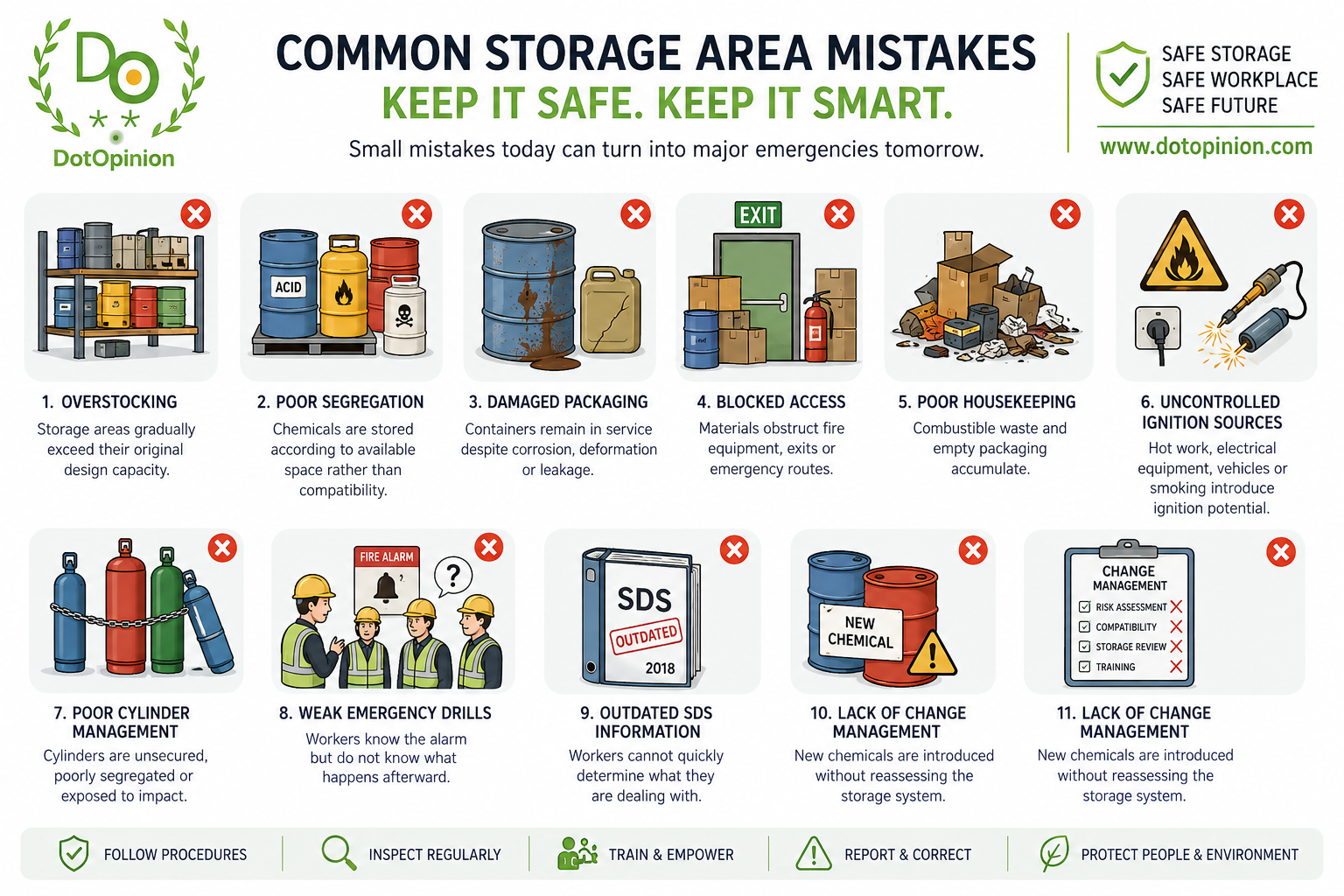
Storage areas gradually exceed their original design capacity.
Poor segregation
Chemicals are stored according to available space rather than compatibility.
Damaged packaging
Containers remain in service despite corrosion, deformation or leakage.
Blocked access
Materials obstruct fire equipment, exits or emergency routes.
Poor housekeeping
Combustible waste and empty packaging accumulate.
Uncontrolled ignition sources
Hot work, electrical equipment, vehicles or smoking introduce ignition potential.
Poor cylinder management
Cylinders are unsecured, poorly segregated or exposed to impact.
Weak emergency drills
Workers know the alarm but do not know what happens afterward.
Outdated SDS information
Workers cannot quickly determine what they are dealing with.
Lack of change management
New chemicals are introduced without reassessing the storage system.
Building a Stronger HSE Culture Around Storage
A mature HSE culture does not ask:
“Did we complete the inspection?”
It asks:
“Did the inspection reduce risk?”
It does not ask:
“Do we have an emergency plan?”
It asks:
“Could our people execute the plan under pressure?”
It does not ask:
“Is the chemical labelled?”
It asks:
“Would a new employee understand the hazard immediately?”
This change in thinking is important.
Safety is not the existence of documents.
Safety is the effectiveness of controls.
Final Thoughts From the Field
Storage areas can look quiet.
That is precisely why they can be dangerous.
A warehouse does not have to look like a chemical plant to contain serious process-safety hazards.
A few drums of solvent, cylinders of gas, oxidizing chemicals, combustible packaging and a forklift operating in the same area can create a complex risk picture.
The job of the HSE professional is not to make storage areas look safe.
It is to understand what can happen when the normal controls fail.
HSE preparedness in storage areas therefore has to go beyond signs, PPE and fire extinguishers.
It requires:
- Proper hazard identification
- Chemical classification
- Compatibility assessment
- Appropriate storage design
- Segregation
- Ventilation
- Fire protection
- Spill containment
- Safe handling
- Competent personnel
- Emergency procedures
- Environmental protection
- Drills
- Inspection
- Incident learning
- Continual improvement
The most important emergency response is still the emergency that never happens.
And preventing that emergency begins long before the alarm sounds.
A Final Question for Every HSE Professional
Walk into your storage area today and select one hazardous material.
Do not look at the label first.
Ask yourself:
“If this container fails completely, where will the material go, what will it react with, who could be exposed, what could ignite, how would we detect it, how would we isolate it, and could our emergency team safely respond?”
If you cannot answer those questions, your storage system may be compliant on paper but not yet prepared for the real world.
That is where effective HSE preparedness in storage areas begins.
Author’s Note
I believe the best HSE knowledge is knowledge that can survive outside the office.
Standards, procedures, risk assessments and checklists are important, but they only become meaningful when they are translated into practical controls that workers can understand and apply.
Storage safety is one of those areas where experience matters because the hazard is often hidden in the combination of materials, quantities, people, equipment and environmental conditions.
The objective should never be simply to pass an audit.
The objective should be to make sure that when something unexpected happens, the organization is ready before the situation becomes irreversible.
Authoritative Resources for Further Reading
For readers who want to go deeper, the following organizations provide useful technical and regulatory information:
- OSHA — Flammable Liquids: OSHA 1910.106 Flammable Liquids
- OSHA — Compressed Gas Cylinders: OSHA Compressed Gas Cylinder Guidance
- ISO — Emergency Preparedness: ISO Emergency Preparedness Guidance
- UNECE — Dangerous Goods Model Regulations: UNECE Dangerous Goods Model Regulations
- U.S. Chemical Safety Board: U.S. Chemical Safety and Hazard Investigation Board
- Pakistan Environmental Protection Agency: Pakistan Environmental Protection Agency
- Sindh Laws: Sindh Code

 By
By