
Introduction
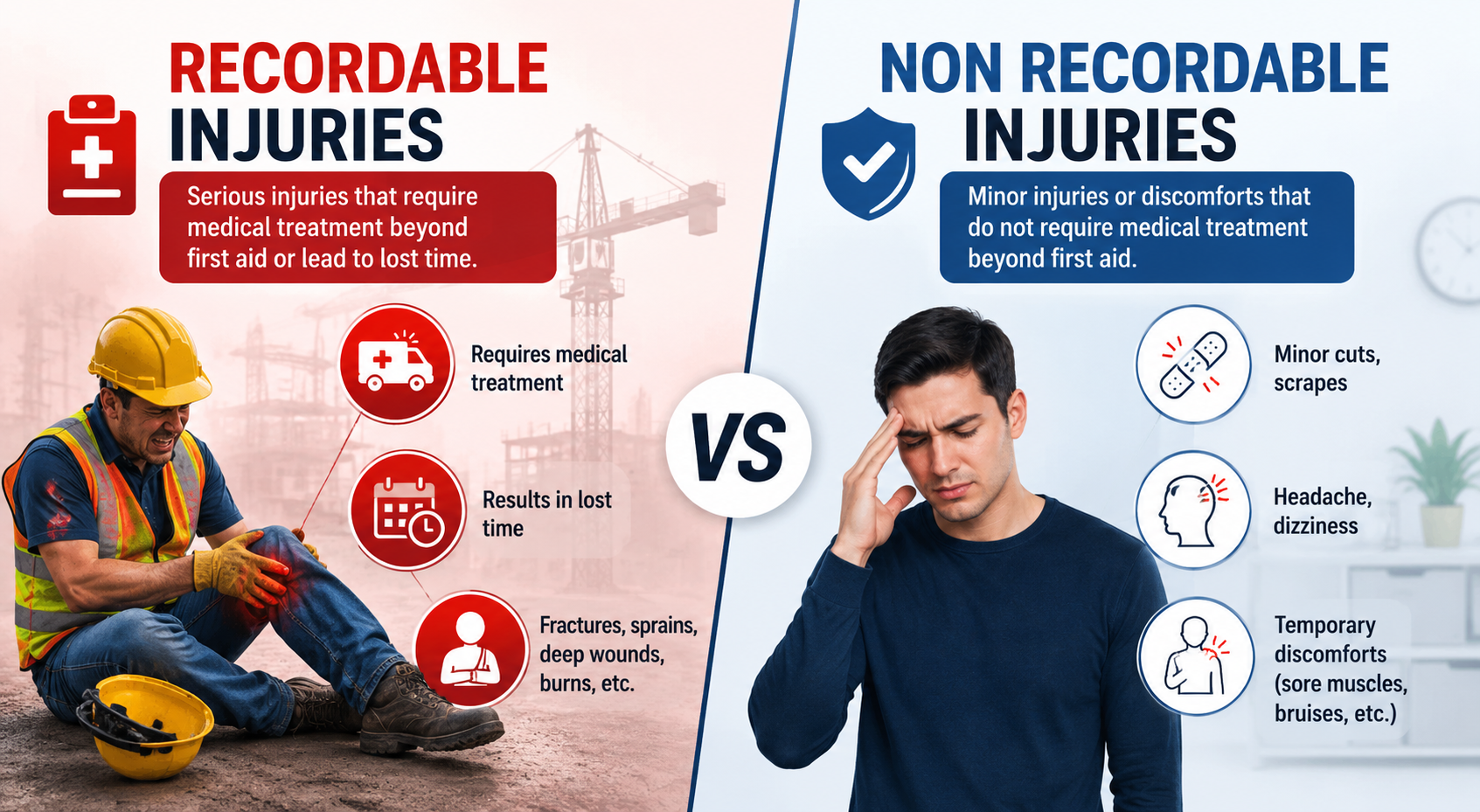
Workplace safety management depends heavily on accurate data. Employers, safety professionals, regulators, and workers all rely on injury and illness statistics to identify hazards, measure the effectiveness of safety programs, and hold organizations accountable for maintaining safe working conditions. At the center of this data collection process lies a critical distinction: the difference between a “recordable” injury and a “non-recordable” injury. This classification, governed primarily by the Occupational Safety and Health Administration (OSHA) in the United States, determines what must be logged, reported, and tracked as part of an employer’s official injury and illness records. Understanding this distinction is essential not only for regulatory compliance but also for building a genuine culture of safety within an organization.
The Regulatory Foundation: OSHA Record keeping Requirements
OSHA’s recordkeeping regulations are found in 29 CFR Part 1904, which requires most employers with more than ten employees, operating in industries not specifically exempted, to keep records of serious occupational injuries and illnesses. These records are maintained using three primary forms:
- OSHA Form 300 (Log of Work-Related Injuries and Illnesses): A running log of all recordable cases during the year.
- OSHA Form 300A (Summary of Work-Related Injuries and Illnesses): An annual summary posted in the workplace, typically from February 1 to April 30 of the following year.
- OSHA Form 301 (Injury and Illness Incident Report): A detailed report for each individual recordable case, documenting how the injury occurred.
The purpose of these records is not punitive but informational. They allow employers to identify patterns, trends, and problem areas, while also giving OSHA and researchers the ability to analyze injury rates across industries.
Defining a Recordable Injury
An injury or illness is considered recordable under OSHA guidelines if it is work-related and results in one or more of the following outcomes:
- Death — Any work-related fatality must be recorded, and fatalities must also be reported to OSHA within eight hours.
- Days away from work — If an employee is unable to work for one or more days following the injury, it is recordable.
- Restricted work or transfer to another job — If the employee’s normal work duties are limited, or they are moved to a different job because of the injury.
- Medical treatment beyond first aid — This is one of the most significant and commonly misunderstood criteria, discussed further below.
- Loss of consciousness — Any work-related incident causing an employee to lose consciousness is automatically recordable, regardless of other factors.
- A significant injury or illness diagnosed by a physician or other licensed healthcare professional — Examples include a cancer diagnosis, a fractured or cracked bone, or a punctured eardrum, even if no other recording criteria are met.
- Needlestick and sharps injuries — These are recordable when they involve contamination with another person’s blood or other potentially infectious material, even absent other listed criteria.
- Hearing loss — A Standard Threshold Shift (STS) of 10 dB or more in one or both ears, combined with an overall hearing level of 25 dB or more above audiometric zero, is recordable.
- Tuberculosis — Cases where an employee has been occupationally exposed and subsequently develops a tuberculosis infection.
For an injury to be recordable, it must first meet OSHA’s definition of “work-related.” An injury is presumed work-related if an event or exposure in the work environment either caused or contributed to the injury or illness, or significantly aggravated a pre-existing condition. There are specific exceptions—for example, injuries occurring during voluntary participation in a wellness program, or injuries sustained while commuting to or from work, are generally not considered work-related.
The First Aid vs. Medical Treatment Distinction
Perhaps the most consequential — and most frequently misapplied — element of the recordability determination is the line between “first aid” and “medical treatment beyond first aid.” OSHA maintains a specific, exhaustive list of treatments that qualify as first aid. If the treatment provided falls within this list, the case is generally non-recordable (assuming no other recordable criteria, such as days away from work, are triggered). OSHA’s list of first aid treatments includes, among others:
- Using non-prescription medication at nonprescription strength
- Administering tetanus immunizations
- Cleaning, flushing, or soaking wounds on the skin surface
- Using wound coverings such as bandages, gauze pads, or butterfly bandages (as opposed to sutures or staples)
- Using hot or cold therapy
- Using temporary immobilization devices while transporting an injured person
- Drilling a fingernail or toenail to relieve pressure
- Using eye patches
- Removing foreign bodies from the eye using only irrigation or a cotton swab
- Removing splinters or foreign material from areas other than the eye by irrigation, tweezers, cotton swabs, or other simple means
- Using finger guards
- Using massages
- Drinking fluids to relieve heat stress
If treatment goes beyond this list — for instance, if a wound requires sutures, if prescription-strength medication is administered, if a fracture requires immobilization with a rigid device, or if physical therapy is prescribed — the case becomes recordable, even if the employee does not miss any work.
Non-Recordable Injuries: What Falls Outside the Log
Non-recordable injuries are incidents that, while they may still represent real harm or discomfort to an employee, do not meet OSHA’s threshold criteria. Common examples include:
- Minor cuts or scrapes treated only with a bandage
- Bruises treated with an ice pack
- Splinters removed with tweezers
- Minor first-degree burns treated with over-the-counter ointment
- Headaches relieved with non-prescription pain relievers
- Muscle soreness managed with rest and non-prescription medication
It’s important to emphasize that “non-recordable” does not mean “not worth documenting.” Prudent employers maintain internal records of all incidents, including minor ones, through incident reports or near-miss logs. This internal documentation serves a different purpose than the OSHA log: it helps identify emerging hazards and trends before they escalate into more serious, recordable events. A high frequency of minor lacerations in a particular area, for example, might reveal a hazard that, left unaddressed, could eventually cause a serious recordable injury.
Why the Distinction Matters
1. Regulatory Compliance and Legal Exposure
Misclassifying injuries — whether by underreporting recordable cases or over-recording non-recordable ones — carries real consequences. Underreporting can result in OSHA citations, fines, and in serious cases, allegations of willful falsification of records, which can carry criminal liability. Accurate classification is thus a matter of legal necessity, not just administrative housekeeping.
2. Injury Rate Calculations
Recordable injuries form the basis for calculating key safety metrics, including the Total Recordable Incident Rate (TRIR) and the Days Away, Restricted, or Transferred (DART) rate. These metrics are used by insurance companies to set workers’ compensation premiums, by clients to prequalify contractors (particularly in construction and industrial sectors), and by companies internally to benchmark performance against industry averages. An inflated or deflated TRIR — even if unintentional — can distort these comparisons and lead to poor business or safety decisions.
3. Organizational Culture and Incentive Structures
There is an important cautionary dimension to this topic. Some organizations, in an effort to keep their recordable injury rates low, inadvertently create incentive structures that discourage honest reporting. Safety incentive programs that reward employees or teams for “zero recordables” can backfire, pressuring workers to hide injuries, delay treatment to avoid triggering “days away” thresholds, or resist proper medical care altogether. OSHA has explicitly cautioned employers against incentive programs that could deter reporting, and safety professionals widely regard leading indicators (like near-miss reporting rates and safety observations) as healthier metrics to incentivize than lagging indicators like recordable rates alone.
4. Hazard Identification and Prevention
Beyond compliance, the recordable/non-recordable distinction — when applied honestly — is a genuine diagnostic tool. Trends in recordable injury types, body parts affected, and departments involved can reveal systemic hazards. A cluster of recordable shoulder injuries in a warehouse, for instance, might point to a lifting or ergonomics problem requiring engineering controls, rather than simply more training.
Read More About Particulate Matter
Common Pitfalls in Classification
Safety professionals frequently encounter gray areas that require careful judgment:
- Physician recommendations versus actual treatment: If a doctor recommends restricted duty or days away from work, the case is recordable even if the employee, or the employer, chooses not to follow that recommendation.
- Aggravation of pre-existing conditions: An old injury that is significantly worsened by a new work-related event is recordable, whereas a condition that merely and briefly becomes symptomatic without lasting aggravation may not be.
- Second opinions: If any healthcare provider recommends treatment beyond first aid, the case is generally recordable, even if a different physician later provides a more conservative opinion.
- Care furnished by a physician: If a physician evaluates a case and provides any treatment or recommendation exceeding the first-aid list, the case typically becomes recordable — even for something as seemingly minor as prescribing an anti-inflammatory medication at prescription strength.
Conclusion
The distinction between recordable and non-recordable injuries is far more than a bureaucratic technicality — it is a foundational element of how workplace safety is measured, managed, and improved. Recordable injuries capture the more serious end of the harm spectrum: fatalities, lost work time, restricted duty, and medical treatment beyond basic first aid. Non-recordable injuries, while still deserving of attention and internal tracking, fall below this threshold. Getting this classification right requires careful attention to OSHA’s detailed criteria, particularly the nuanced boundary between first aid and medical treatment. Ultimately, the value of this system lies not merely in compliance, but in what accurate, honest injury data makes possible: the identification of hazards, the protection of workers, and the continuous improvement of workplace safety culture.


 By
By