
An Industrial Safety, Storage, and Risk Management Perspective
A Technical Reference for Engineers, EHS Professionals, and Site Operators
CLASS I · CLASS II · CLASS III
1. Introduction
Few categories of industrial material present as broad and persistent a risk profile as flammable and combustible liquids. They are present on nearly every industrial site in some form — as fuels, solvents, feedstocks, coatings, lubricants, or cleaning agents — and they are involved in a disproportionate share of major fires, explosions, and process safety incidents each year. The U.S. Chemical Safety and Hazard Investigation Board (CSB) documented 25 major flammable-chemical incidents between May 2020 and August 2024 alone, resulting in seven fatalities, twenty-three serious injuries, and roughly one billion dollars in combined damage across fourteen states. Separately, the National Fire Protection Association (NFPA) estimates that chemical-related fires in U.S. manufacturing facilities cause approximately $1.5 billion in direct property losses every single year.
From an industrial standpoint, the challenge is not simply recognizing that these liquids are dangerous — most operators already know that — but building a rigorous, layered system of engineering controls, procedural discipline, and organizational culture that keeps the probability of ignition, and the consequence if ignition occurs, as low as reasonably practicable. This report examines flammable and combustible liquids from that industrial lens: how they are classified, why they behave the way they do, what the data tells us about where incidents actually originate, and what a mature industrial safety program looks like in practice.
Table of Contents
2. Classification: The Engineering Basis for Every Decision That Follows
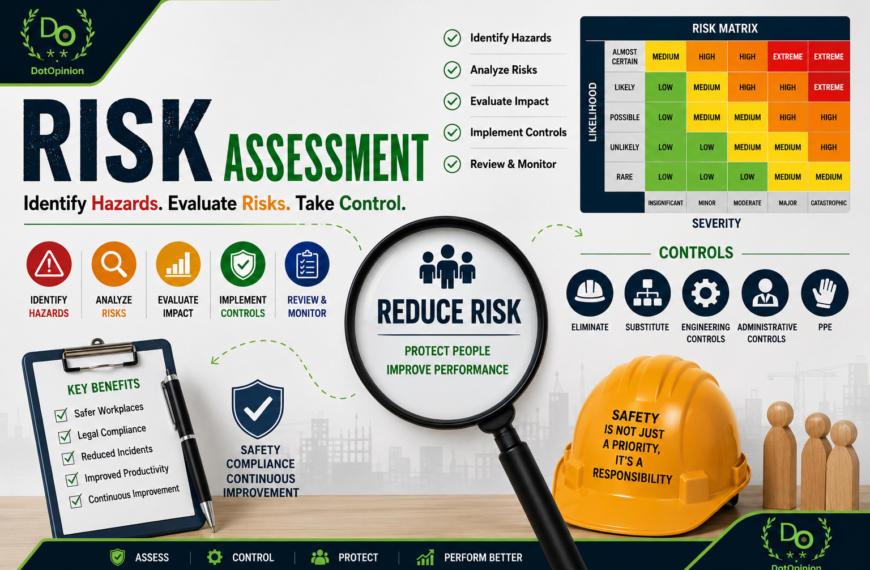
Every storage limit, ventilation requirement, electrical classification, and PPE specification in an industrial flammable-liquids program traces back to a single measured property: flash point — the lowest temperature at which a liquid releases enough vapor to form an ignitable mixture with air at its surface. In the United States, OSHA’s Hazard Communication-aligned system (29 CFR 1910.106, harmonized with GHS) divides liquids into four numbered categories, while NFPA 30 uses a parallel Class I/II/III lettering system that most industrial safety teams reference day to day.
2.1 The classification table
The table below cross-references the two systems most industrial EHS teams work with simultaneously.
| NFPA 30 Class | OSHA/GHS Category | Flash Point Range | Typical Examples |
| Class IA | Category 1 | < 22.8°C (73°F), boiling point ≤ 35°C (95°F) | Diethyl ether, pentane |
| Class IB | Category 2 | < 22.8°C (73°F), boiling point > 35°C (95°F) | Gasoline, acetone, toluene |
| Class IC | Category 3 (low end) | 22.8°C – 37.8°C (73°F–100°F) | Turpentine, some paint thinners |
| Class II | Category 3 (high end) | 37.8°C – 60°C (100°F–140°F) | Diesel fuel, kerosene, mineral spirits |
| Class IIIA | Category 4 | 60°C – 93°C (140°F–200°F) | Fuel oil, lubricating oils, some solvents |
| Class IIIB | Not separately classed | ≥ 93°C (200°F) | Vegetable oils, most mineral/hydraulic oils |
Table 1. NFPA 30 vs. OSHA/GHS liquid classification, cross-referenced by flash point.
2.2 Flash points of common industrial liquids
Figure 1 places several liquids that recur constantly across manufacturing, warehousing, transport, and maintenance operations on a single flash-point scale. Notice how far to the left — into deeply sub-zero territory — genuinely high-hazard Class I materials like gasoline and acetone sit compared with combustible Class III oils that dominate the right-hand side of the chart.
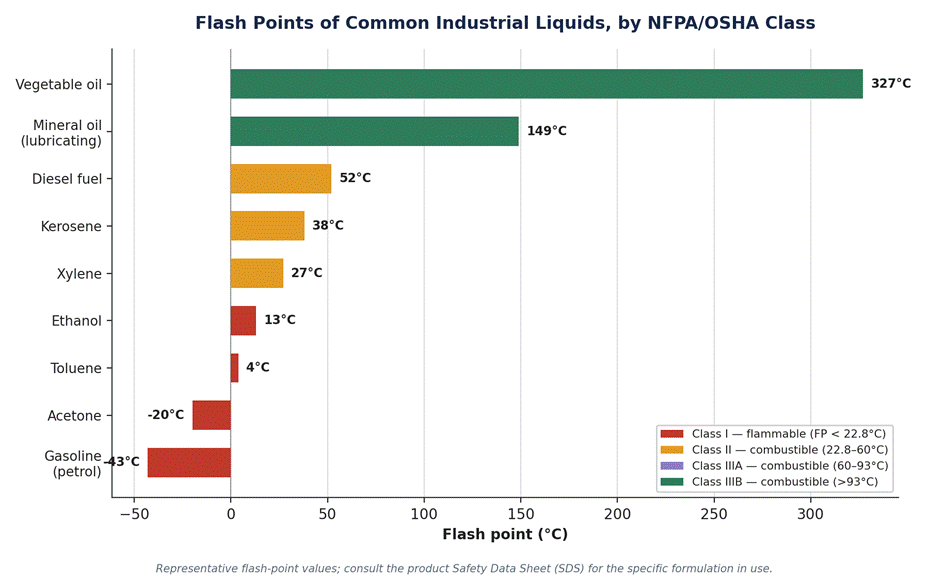
Figure 1. Flash points of common industrial liquids, colored by hazard class.
3. Why Vapor — Not Liquid — Is the True Hazard
Liquids themselves do not burn. What burns is the vapor-air mixture generated above and around a liquid’s surface once enough of it has evaporated. This single fact drives nearly every industrial control measure discussed in this report, and it explains several counter-intuitive realities that experienced safety professionals learn to respect.
3.1 The flammable range
Every flammable or combustible vapor has a lower flammable limit (LFL) and an upper flammable limit (UFL) — the band of vapor concentration in air within which ignition is physically possible. Below the LFL, the mixture is too lean to sustain combustion; above the UFL, it is too rich. Gasoline vapor, for example, is flammable across roughly 1.4% to 7.6% concentration in air. Industrial ventilation design exists largely to keep ambient vapor concentrations from ever approaching the LFL in the first place, using percentage-of-LFL alarm setpoints (commonly 10% and 25% of LFL) on fixed gas detection systems.
3.2 Vapor density and travel
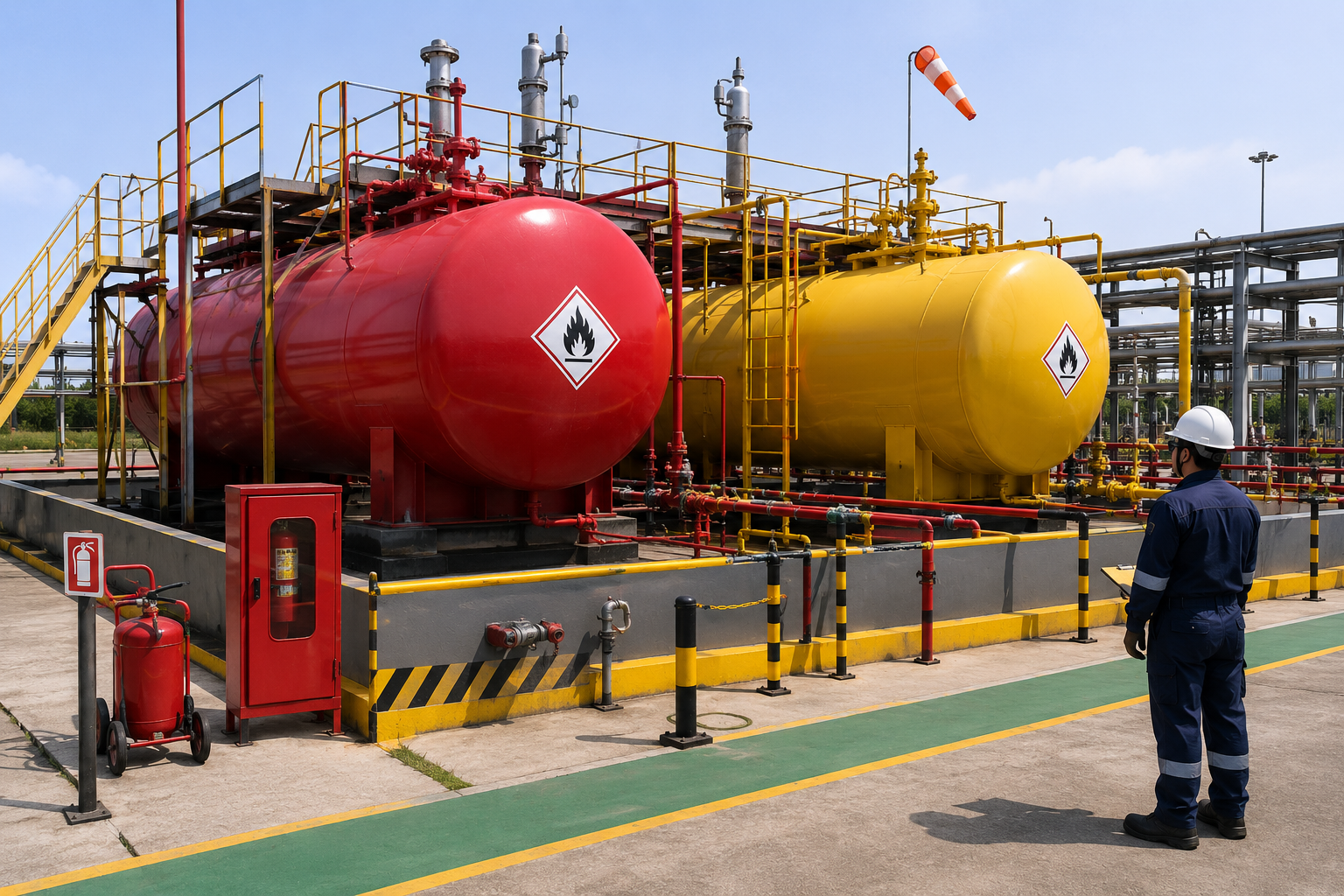
Most flammable vapors are heavier than air — gasoline vapor, for instance, is roughly three to four times denser than air — which means they sink, pool in low points such as pits, trenches, and sumps, and can travel considerable horizontal distances along the floor before reaching an ignition source. This is why area classification (Class I, Division 1/2 or Zone 0/1/2 under the National Electrical Code and IEC systems) extends outward and downward from a source of release, not just immediately around it, and why floor-level ignition sources — a spark from dragging a metal drum, a pilot light near floor level — are disproportionately implicated in incidents.
3.3 Static electricity and switch loading
A recurring theme in CSB incident investigations is static discharge generated during the transfer of low-conductivity (‘nonconductive’) flammable liquids — a mechanism formally established in the CSB’s investigation of the 2007 Barton Solvents explosion in Valley Center, Kansas, where a static spark from a loosely bonded level-measuring float ignited vapor inside a storage tank during filling. A related and frequently underestimated hazard is switch loading — introducing a low-vapor-pressure (high flash point) liquid into a tank or compartment that previously held a high-vapor-pressure (low flash point) product — which the CSB has found can generate dangerous static accumulation on the liquid surface during loading, even when the liquid being loaded would not normally be considered high-risk.
4. What the Incident Data Actually Shows
Numbers change the conversation from ‘this could theoretically happen’ to ‘this is happening, repeatedly, across the industry, right now.’ Two independent data sets are worth examining side by side.
4.1 NFPA large-loss fire data
NFPA tracks fires and explosions causing at least $10 million in direct property damage. In 2024, NFPA researchers identified 30 such large-loss incidents across the United States. Manufacturing and storage properties together accounted for seven of the thirty — meaning industrial occupancies represented close to a quarter of the year’s most catastrophic fire losses, despite representing a much smaller share of total building stock than residential or commercial property.
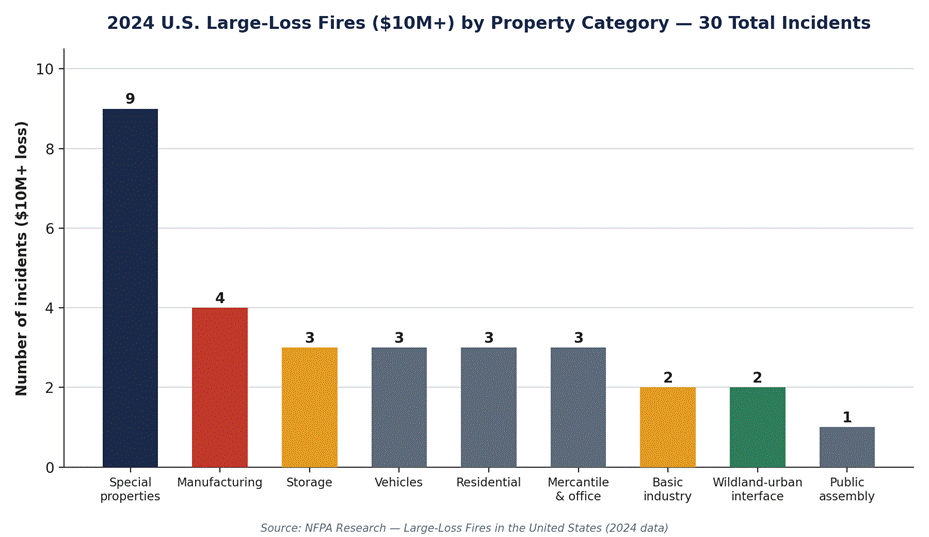
Figure 2. 2024 U.S. large-loss fires ($10M+) by property category (NFPA Research).
4.2 Chemical Safety Board findings
The CSB’s more targeted look at flammable-chemical incidents specifically — rather than fires in general — tells a sharper story. Between May 2020 and August 2024, the board documented 25 major incidents spanning fourteen states, with outcomes summarized in Figure 3. What stands out in CSB casework is how often the root cause traces not to exotic engineering failure but to procedural gaps: missed venting steps, inadequate hazard review of routine tasks, insufficient bonding and grounding during transfer, and — in more than one case — a complete absence of formal hazard analysis for an operation employees had performed the same way for years.
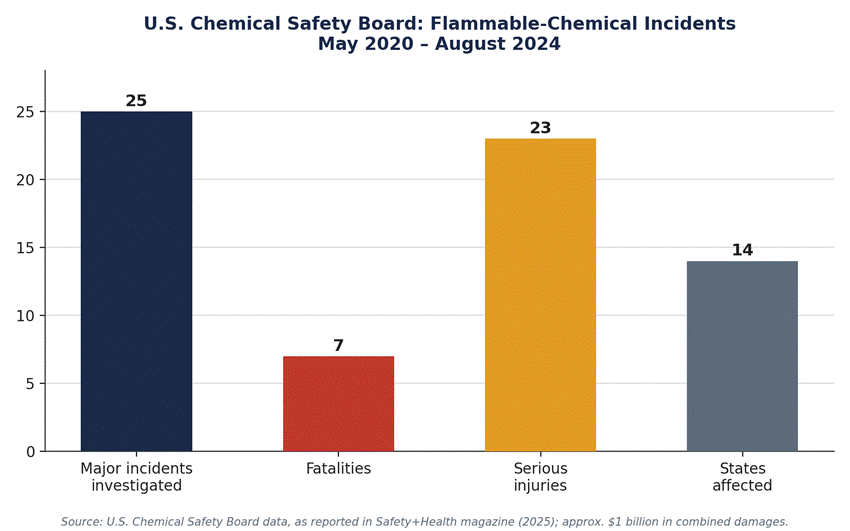
Figure 3. CSB-documented flammable-chemical incident outcomes, May 2020–August 2024.
5. Industrial Storage: Engineering the Quantity and the Container
Storage strategy in an industrial setting is fundamentally about limiting three variables simultaneously: how much liquid is present, how it is contained, and how far it sits from an ignition source or an occupied space. OSHA’s 29 CFR 1910.106 sets the U.S. regulatory floor; NFPA 30 provides the more detailed and more frequently updated engineering guidance that most large facilities design to.
5.1 Maximum allowable quantities
Figure 4 shows the stepped allowance structure that governs how much flammable liquid can be present in different storage configurations within a single fire area. Notice how dramatically capacity increases once liquid is placed inside an approved, fire-rated cabinet — the cabinet itself is engineered to hold internal temperature below 325°F for at least ten minutes under a standard fire-test curve, buying critical time for suppression systems and evacuation.
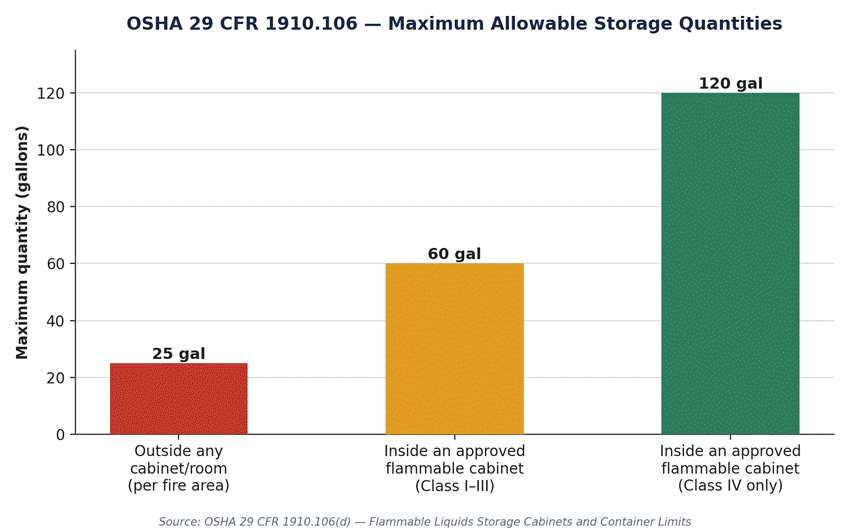
Figure 4. OSHA 29 CFR 1910.106 maximum allowable storage quantities by configuration.
| Storage Configuration | Maximum Quantity | Key Design Requirement |
| Outside any cabinet or room, per fire area | 25 gallons (Class I–III combined) | Kept in approved safety cans or closed containers |
| Inside one approved flammable storage cabinet | 60 gal (Class I–III) / 120 gal (Class IV) | 18-gauge double-wall steel, 1.5″ air gap, self-closing 3-point latch |
| Cabinets permitted in a single fire area | Max. 3 cabinets | Additional groups require 100 ft separation |
| Dedicated inside liquid storage room | Varies by construction rating | 1-hour or 2-hour fire-rated construction, mechanical ventilation, spill containment |
| Outdoor storage / tank farm | Governed by NFPA 30 Ch. 22 | Diking, drainage, spacing from property lines and buildings |
Table 2. Industrial storage configurations and their governing limits.
5.2 Container and cabinet practice
Beyond bulk quantity limits, day-to-day industrial discipline around containers is where most citable violations actually occur. Common findings include liquids stored in unapproved or improperly sealing containers, safety cans lacking spring-closing lids or flame arrestors, oily rags left to accumulate rather than stored in self-closing waste cans (a well-documented spontaneous-combustion risk with drying oils such as linseed oil), and incompatible materials — most dangerously oxidizers — stored adjacent to flammable stock.
- Use only listed/approved safety cans and drums rated for the liquid class in use.
- Bond and ground both containers during any transfer operation to prevent static discharge.
- Empty oily-rag waste cans daily or at the end of each shift.
- Segregate oxidizers, acids, and reactive materials from flammable and combustible stock.
- Keep containers closed except when actively dispensing.
- Never exceed the rated capacity of a storage cabinet or storage room.
Read more about Occupational Health & Safety
6. Engineering and Administrative Controls
A mature industrial program layers multiple independent controls so that the failure of any single one does not lead directly to a fire or explosion. This layered approach — sometimes visualized as the ‘Swiss cheese model’ of accident causation — is standard practice in process safety engineering.
6.1 Area classification and electrical equipment
Any space where flammable vapors may be present under normal or abnormal operating conditions must be classified under the National Electrical Code (Class I, Division 1 or 2, or the equivalent IEC Zone 0/1/2 system), and only intrinsically safe or explosion-proof electrical equipment may be installed there. Portable tools, lighting, and even mobile phones brought into classified areas must meet the same rating.
6.2 Ventilation
Mechanical ventilation — typically designed to achieve a minimum air-change rate and to draw air from low points where heavier-than-air vapors accumulate — is the primary engineering control for keeping ambient vapor concentration below actionable percentages of the LFL. Fixed gas detectors tied to alarm and shutdown logic provide continuous verification that ventilation is performing as designed.
6.3 Fire suppression: why water alone fails
Flammable and combustible liquid fires are classified as Class B fires. Water is frequently ineffective and can be actively dangerous on some Class B fires — it can spread a burning liquid across a wider surface or, with liquids lighter than water, simply float beneath the burning layer without extinguishing it. Effective suppression instead relies on smothering the fuel-air interface: aqueous film-forming foam (AFFF) or alternative fluorine-free foam blankets the liquid surface and excludes oxygen, dry chemical agents interrupt the chemical chain reaction, and CO2 or clean agents displace oxygen in enclosed equipment spaces. Facility fire protection engineers size foam concentrate storage, application rate, and deluge or sprinkler design specifically to the liquid classes present, per NFPA 30 Chapter 16 requirements for automatic protection of liquid storage rooms and warehouses.
6.4 Secondary containment
Diking, curbing, and sloped drainage around bulk storage tanks and process areas ensure that a leak or catastrophic tank failure is contained on-site rather than spreading toward ignition sources, drainage systems, or waterways — a requirement now anchored directly in NFPA 30’s Chapter 6 base requirements for drainage, containment, and spill control.
7. Regulatory and Standards Framework
Industrial facilities in the United States typically design to a stack of overlapping requirements rather than any single document. The table below summarizes the primary instruments and what each one actually governs.
| Instrument | Issuing Body | Primary Scope |
| 29 CFR 1910.106 | OSHA | Legally enforceable minimum requirements for storage, handling, and use of flammable liquids |
| 29 CFR 1910.119 (PSM) | OSHA | Process safety management for facilities exceeding threshold quantities of highly hazardous chemicals, including many Class I liquids above 10,000 lb |
| NFPA 30 | NFPA | Detailed, frequently updated engineering guidance for tanks, containers, storage rooms, and processing facilities; widely incorporated by reference into OSHA enforcement |
| NFPA 70 (NEC) | NFPA | Electrical area classification and equipment requirements for hazardous locations |
| GHS / 29 CFR 1910.1200 | UN / OSHA | Hazard classification, labeling, and Safety Data Sheet (SDS) requirements |
| 40 CFR 264 / EPA RMP | EPA | Environmental release prevention, secondary containment, and risk management planning |
Table 3. Overlapping regulatory and standards framework for flammable/combustible liquids.
8. Lessons From Real Industrial Incidents
Case history remains one of the most effective training tools in industrial safety, precisely because it replaces abstract probability with concrete cause and effect.
8.1 Barton Solvents, Valley Center, Kansas (2007)
A static spark generated by a loosely bonded level-measuring float ignited flammable vapor inside a tank during a filling operation, producing an explosion and fire at the distribution facility. The CSB’s investigation specifically flagged nonconductive flammable liquids as a distinct hazard category, since they can retain static charge longer than conductive liquids and are more prone to this failure mode — a finding that reshaped industry guidance on bonding practices for these products.
8.2 BioLab, Conyers, Georgia (2024)
A malfunctioning sprinkler system introduced water into contact with a strong oxidizer stored on site, triggering a violent reaction that released chlorine gas and ignited nearby combustible materials. Local authorities evacuated roughly 17,000 residents and ordered another 90,000 to shelter in place. The facility had a lengthy history of prior regulatory violations, illustrating how unresolved, seemingly isolated compliance gaps can compound over years into a community-scale emergency.
8.3 The recurring pattern
Across CSB casework more broadly, a small number of root-cause patterns recur far more often than exotic engineering failures: switch loading and static accumulation during transfer, inadequate hazard review of routine or ‘always done it this way’ tasks, missed procedural steps during purging or venting, and reliance on human vigilance in place of engineered safeguards for foreseeable abnormal situations. None of these are exotic. All are preventable with disciplined process safety management.
9. Personal Protective Equipment and the Human Factor
Engineering controls set the ceiling on how safe a facility can be; training and culture determine how close day-to-day operations actually get to that ceiling. Appropriate PPE for flammable-liquid handling typically includes flame-resistant (FR) clothing rated for the specific arc- or flash-fire exposure present, chemical-resistant gloves matched to the liquid in use (nitrile and neoprene perform very differently against different solvents), indirect-vent or splash goggles, and, in confined-space or high-vapor-concentration work, supplied-air respiratory protection.
But equipment alone does not prevent incidents. NFPA and OSHA guidance converges on a small set of organizational practices that consistently separate high-performing sites from the rest: documented and refreshed training tied to actual job tasks rather than generic modules, a functioning hot-work permit system with a dedicated fire watch, pre-task hazard reviews for any nonroutine activity, and a culture where stopping work to question an unsafe condition is genuinely supported rather than merely stated in a policy manual. The training and drill requirements referenced in OSHA 1910.120 and NFPA 600 are not paperwork exercises — they are the mechanism by which engineered controls actually get used correctly under pressure.
10. Emergency Preparedness and Response
Even a well-controlled facility must plan for the credible worst case. Effective emergency response for flammable and combustible liquid incidents typically includes pre-identified isolation and shutdown procedures, mutual-aid agreements with the local fire department that account for the specific foam agents and application equipment the facility relies on, spill kits and absorbent material staged near likely release points rather than in a central store, and a clear, drilled evacuation and shelter-in-place decision structure — since, as the BioLab incident showed, the appropriate protective action for surrounding communities can shift rapidly once a reaction is underway.
Mutual-aid pre-planning deserves particular emphasis. Municipal fire departments often do not stock the volume of foam concentrate a large industrial tank fire would require; NFPA 30’s fire-protection annexes exist specifically to help facility engineers size on-site or nearby suppression resources to the realistic worst-case scenario rather than to an average incident.
11. Conclusion
Flammable and combustible liquids will remain embedded in industrial operations for the foreseeable future — there is no realistic substitute for many fuels, solvents, and process liquids across manufacturing, energy, transportation, and logistics. What separates a well-run site from a future CSB case study is not the absence of these materials but the discipline applied around them: accurate classification, quantity control, ventilation and area classification, bonding and grounding during transfer, layered fire protection matched to Class B hazards, and a workforce trained to recognize and respect vapor behavior rather than only the visible liquid. The data is unambiguous on this point — the overwhelming majority of documented incidents trace back to control measures that existed on paper but were not consistently engineered, verified, or followed in practice. Closing that gap between written procedure and operational reality is, in the end, the entire discipline of industrial flammable-liquids safety.
Sources referenced: NFPA Research, “Large-Loss Fires in the United States” (2024 data); NFPA 30, Flammable and Combustible Liquids Code (2024 ed.); U.S. Chemical Safety and Hazard Investigation Board (CSB) incident data and investigation reports, including the Barton Solvents (2007) final report and Volume 3 chemical incident trend reporting; OSHA 29 CFR 1910.106 and 1910.119; and Safety+Health magazine (National Safety Council), “Flammable chemical storage” (2025).

 By
By