
Introduction
Lithium-ion (Li-ion) batteries have become the cornerstone of modern energy storage, powering everything from smartphones and laptops to electric vehicles and industrial equipment . Their high energy density, low self-discharge rate, and long lifespan make them the preferred choice for a rapidly electrifying world . However, the very chemistry that gives these batteries their superior performance also presents unique and significant safety challenges. As the global demand for Li-ion batteries surges—expected to rise twentyfold from 2020 levels to reach 2,500 GWh by 2030—understanding their associated hazards, risks, and proper fire response techniques is more critical than ever . This blog post delves into the dangers of lithium-ion batteries, the phenomenon of thermal runaway, and the specialised fire extinguishers designed to mitigate these incidents.
The Hazards: What Makes Lithium-Ion Batteries a Fire Risk?
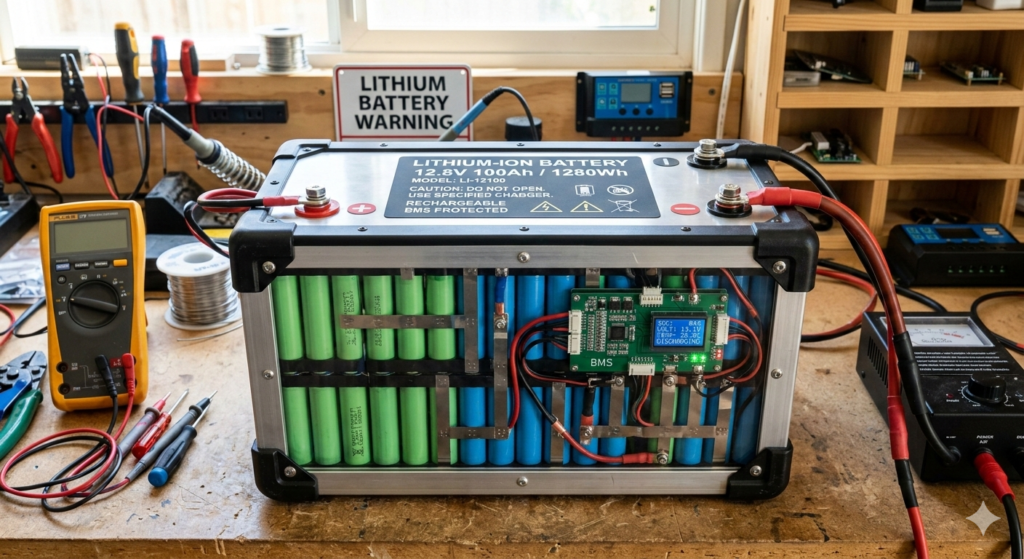
The primary danger associated with lithium-ion batteries is their potential to enter a state of thermal runaway. This is a chain reaction within a single battery cell that leads to overheating and can rapidly propagate to adjacent cells. Thermal runaway is typically triggered by one of three main types of abuse :
- Electrical Abuse: This includes overcharging the battery beyond its voltage limit or exposing it to a short circuit. A malfunctioning Battery Management System (BMS) or using incorrect charging equipment can lead to overcharging. This causes the electrolyte to decompose and lithium dendrites to form, which can pierce the internal separator and cause an internal short circuit .
- Thermal Abuse: Exposure to high external temperatures, such as a fire, direct sunlight, or a hot surface, can push the battery beyond its stable temperature range. This triggers the decomposition of internal components and exothermic (heat-generating) side reactions .
- Mechanical Abuse: Physical damage like puncturing, crushing, or strong vibrations (e.g., from a car crash or rough transport) can compromise the battery’s internal structure, leading to short circuits and the onset of thermal runaway .
The consequences of a battery entering thermal runaway are severe. A fire can erupt that is difficult to extinguish, potentially leading to explosions, especially if flammable gases accumulate in an enclosed space . Furthermore, burning batteries release a cocktail of toxic substances, including hydrogen fluoride (HF) , carbon monoxide (CO), and methane (CH₄). Hydrogen fluoride is particularly dangerous, as it can cause severe corrosion to human tissue and systemic toxicity even at very low doses .
Risk Recommendations for Safe Handling
Managing the risks of Li-ion batteries requires a proactive approach throughout their entire lifecycle, from storage to disposal. Key recommendations include:
- Proper Storage: Store batteries in a cool, dry place away from direct sunlight, heat sources, and flammable materials. For damaged or end-of-life batteries, they must be isolated, stored in fire-resistant containers, and clearly labelled to alert others of the potential danger .
- Safe Charging Practices: Always use the charger specifically designed for the battery. Avoid leaving batteries charging unattended for long periods, and never use a battery that shows signs of damage or swelling .
- Regular Inspection: Routinely check batteries for any physical abnormalities, such as bulging, leaking, or unusual heat generation. If any are found, discontinue use immediately and handle the battery as damaged goods .
- Emergency Planning: Workplaces and individuals should have a clear plan for a battery fire. For businesses storing large quantities, this is a legal requirement. In any emergency, personal safety is the priority. If a fire occurs, evacuate the area immediately and contact emergency services .
The Challenge of Extinguishing a Lithium-Ion Fire
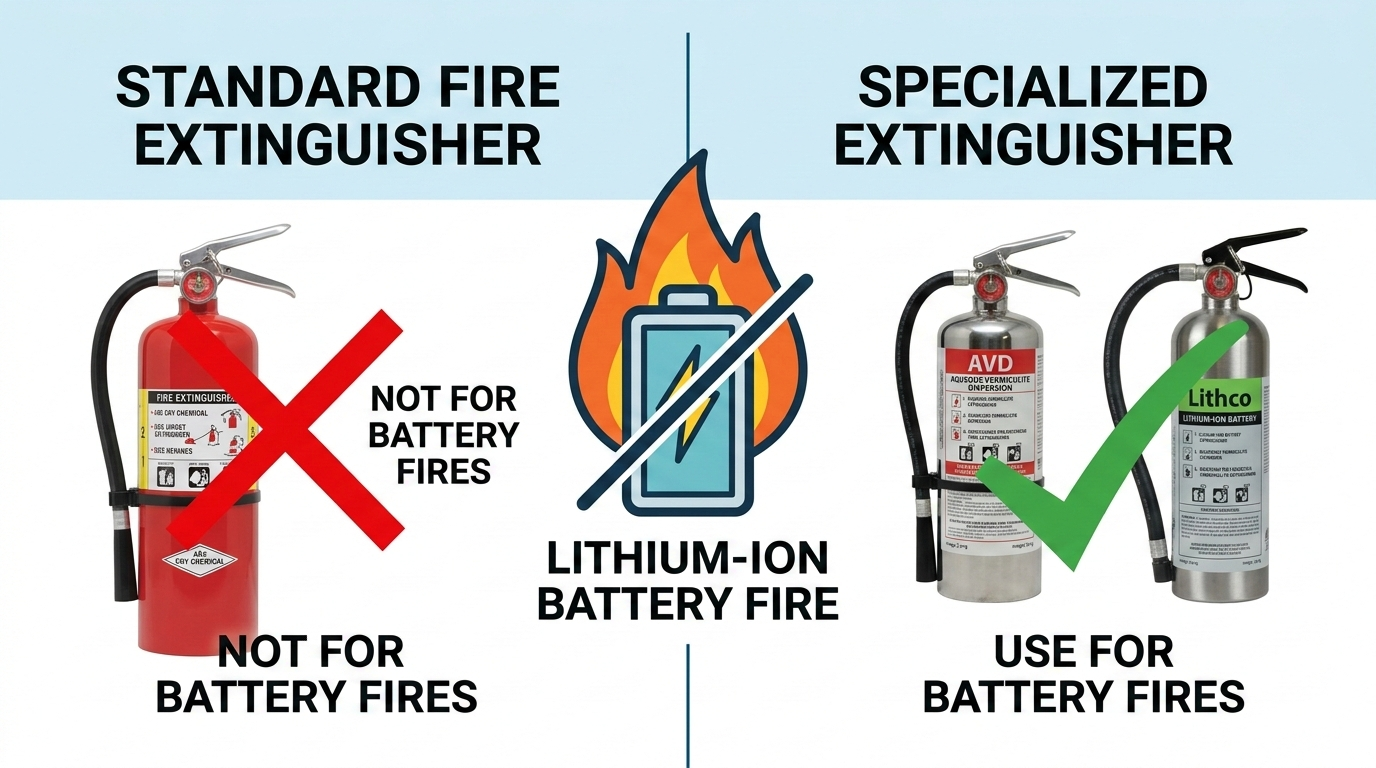
Traditional fire extinguishers are largely ineffective against lithium-ion battery fires. A standard extinguisher may temporarily knock down visible flames, but it often cannot stop the ongoing thermal runaway within the battery cell. The heat inside continues to build, leading to re-ignition minutes or even hours later. This is why simply submersion in water, while potentially effective for small devices, is not a practical or safe large-scale solution and creates toxic runoff . Effective suppression requires both extinguishing the flame and providing intense cooling to halt the thermal reaction.
Specialised Fire Extinguishers and Their Composition
To meet the unique demands of Li-ion battery fires, specialised extinguishers have been developed. The two most prominent types work on different but highly effective principles.
1. Aqueous Vermiculite Dispersion (AVD) Extinguishers
AVD extinguishers represent a cutting-edge solution specifically designed for lithium-ion battery fires. An AVD extinguisher contains a unique agent composed of two main parts :
- Water (approx. 83%) : The water component provides the necessary cooling effect to lower the temperature of the burning battery and help stop thermal runaway.
- Vermiculite Dispersion (approx. 17%) : Vermiculite is a naturally occurring, stable mineral. In the extinguisher, it is suspended in the water. When discharged, the water turns to steam, and the vermiculite particles form a thin, oxygen-excluding, and heat-reflecting layer over the battery cells.
This combination is highly effective. The AVD agent can penetrate battery casings and complex cell geometries to reach the heart of the fire. The vermiculite layer not only smothers the fire but also acts as a firebreak, preventing the propagation of thermal runaway to neighbouring cells. It is non-toxic, non-corrosive, and safe for the environment .
The AVD extinguisher is discharged as a fine mist, allowing the vermiculite particles to form a protective, heat-reflecting layer over the burning battery cells.
2. Specialised Water-Based Additive Extinguishers (e.g., Lithco LB6)
Another class of effective extinguishers uses water as a base but incorporates specific chemical additives. A prime example is the Lithco LB6 extinguisher, which uses an additive called “P Foam” .
- Composition: The agent is water-based with a specially formulated additive.
- Mechanism: The low-viscosity agent is designed to penetrate the outer casing of electronic devices and battery packs, reaching the source of the fire deep within. It has been rigorously tested for effectiveness on Li-ion battery fires and is safe to use on live electrical equipment up to 1000v, making it a versatile tool for environments with many electronic devices .
Comparison of Fire Extinguishing Agents for Lithium-Ion Fires
The table below summarises the different types of extinguishing agents and their suitability for Li-ion battery fires .
Conclusion
Lithium-ion batteries are a safe and reliable technology when used correctly, but the consequences of their failure can be severe. The risk of thermal runaway leading to intense, toxic, and difficult-to-extinguish fires is a reality of our electrified world. Understanding the hazards—from the causes of failure to the environmental and health impacts—is the first step in risk mitigation.
Effectively fighting these fires requires moving beyond traditional methods. Specialised extinguishers, such as Aqueous Vermiculite Dispersion (AVD) and advanced water-based additive agents, have been engineered to meet this challenge. They work by not only extinguishing the flame but also by providing the essential cooling needed to halt the thermal chain reaction and prevent re-ignition. For anyone responsible for spaces where lithium-ion batteries are stored, charged, or used in quantity, investing in these specialised suppression systems and developing a comprehensive emergency response plan is not just a recommendation—it is an essential safeguard for people and property.
