
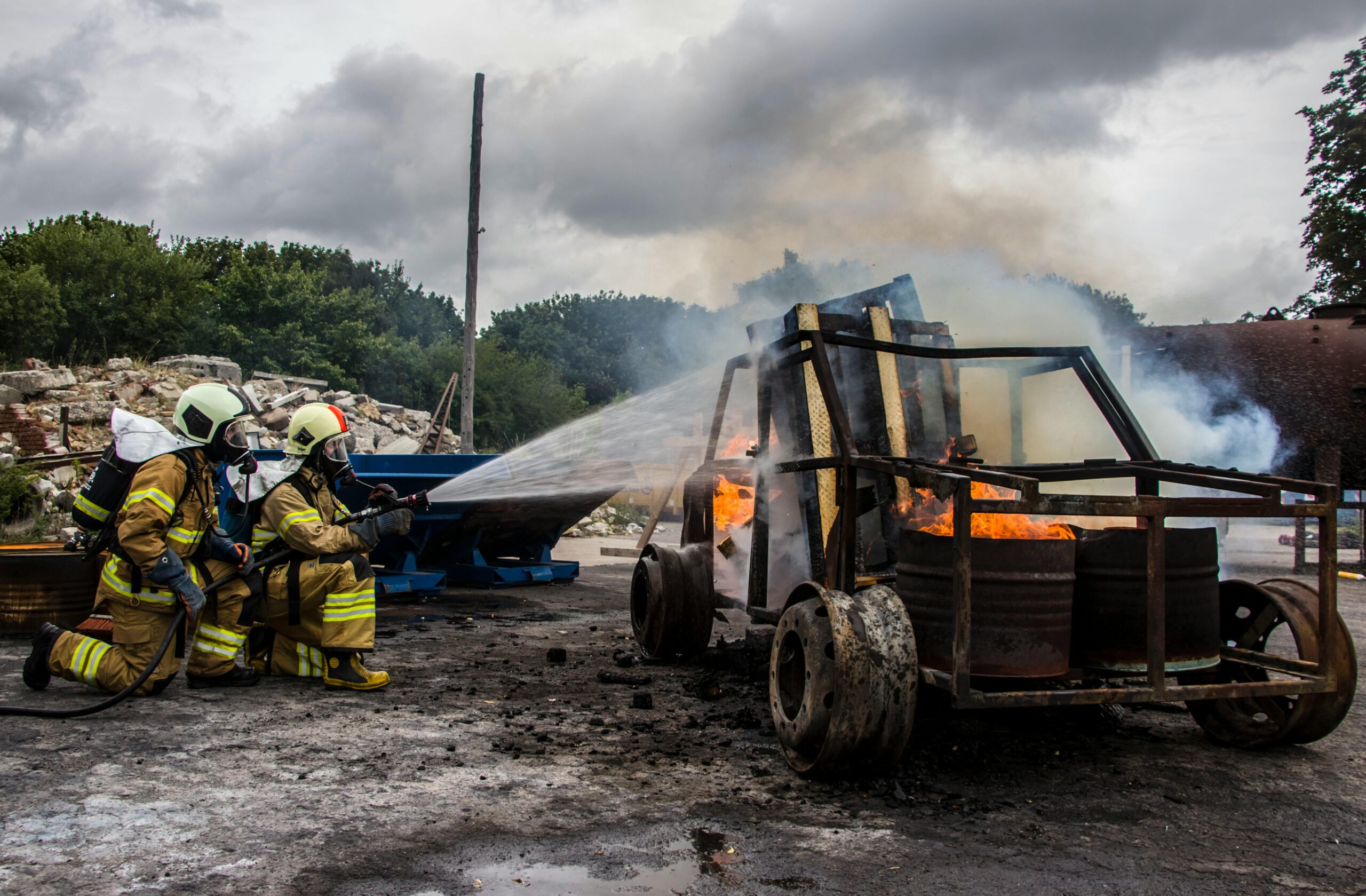
Fire protection in large industrial facilities is not just about installing pumps and tanks — it’s about engineering a complete, reliable system that can perform under worst-case fire conditions. In this guide, we’ll walk through a practical, simplified design example showing how engineers estimate fire demand, size storage tanks, and select diesel fire pumps using accepted international standards.
This article is based on widely used standards from the National Fire Protection Association, especially NFPA 13, NFPA 20, and NFPA 22.
Step 1: Estimating Fire Water Demand
Instead of designing for the entire facility footprint, fire systems are sized for the most hazardous operating area.
Assumed Design Scenario
For a medium-to-high risk industrial zone:
- Hazard area: 20,000 sq.ft
- Water density: 0.15 GPM/sq.ft
- Duration: 60 minutes
Flow Calculation
Q=Area×Density=20,000×0.15=3,000 GPM
This means the system must deliver 3,000 gallons per minute during a fire.
Step 2: Fire Water Storage Tank Sizing
Water storage must sustain the system for the full design duration.Tank Volume=3,000×60=180,000 gallons
Convert to cubic meters:180,000÷264.172≈681 m3
Practical Tank Assumption
Assume an underground concrete rectangular tank with:
- Water depth: 3.5 m
- Required footprint:
Area=681÷3.5≈195 m2
A practical square layout:
👉 14 m × 14 m × 4 m total depth
This includes freeboard and sediment allowance.
Underground tanks are often preferred because they:
- Save space
- Protect water from heat and contamination
- Improve structural safety
Step 3: Fire Pump Selection Logic
The pump must overcome:
- Pipe friction losses
- Elevation differences
- Required residual pressure at discharge points
Industrial systems typically design for:
👉 120–150 psi pump discharge pressure
To ensure at least:
- 20–30 psi residual at remote hydrants
- Adequate sprinkler operating pressure
A 1500–3000 GPM horizontal split-case pump is commonly used for this range.
Step 4: Diesel Backup Fuel Tank Sizing
Diesel fire pumps must operate continuously during emergencies.
Assumed Pump
- Capacity: 1500 GPM
- Estimated fuel use: 18 liters/hour
Minimum Runtime Requirement
Industry practice assumes 8 hours of continuous operation.18×8=144 L
Adding a 100% safety margin:
👉 Recommended diesel storage: 300–400 liters
This ensures:
- Emergency reserve
- Fuel aging tolerance
- Maintenance reliability
Step 5: Accounting for Pipe Length and Layout
Pump pressure is strongly influenced by hydraulic losses:
- Longer pipe runs increase friction
- Elbows and fittings add equivalent length
- Elevation reduces available pressure
Engineers calculate the worst hydraulic path to ensure the pump can deliver required pressure at the most remote point.
Good design practice includes:
- Minimizing sharp bends
- Using larger pipe diameters
- Keeping pumps close to storage tanks
- Looping distribution networks
Step 6: Reliability and Safety Principles
A robust fire water system includes:
- Dedicated fire water storage
- Electric + diesel pump redundancy
- Jockey pump for pressure stability
- Corrosion-resistant tanks
- Proper ventilation and overflow systems
- Routine inspection and maintenance
These features ensure the system performs when needed most.
Final Thoughts
Designing an industrial fire protection system is a balance between engineering calculations and practical reliability. By combining proper demand estimation, tank sizing, pump selection, and fuel storage planning, facilities can achieve a system that is both compliant and dependable.
A well-designed fire water system is not an expense — it’s an investment in life safety, asset protection, and operational continuity.
